
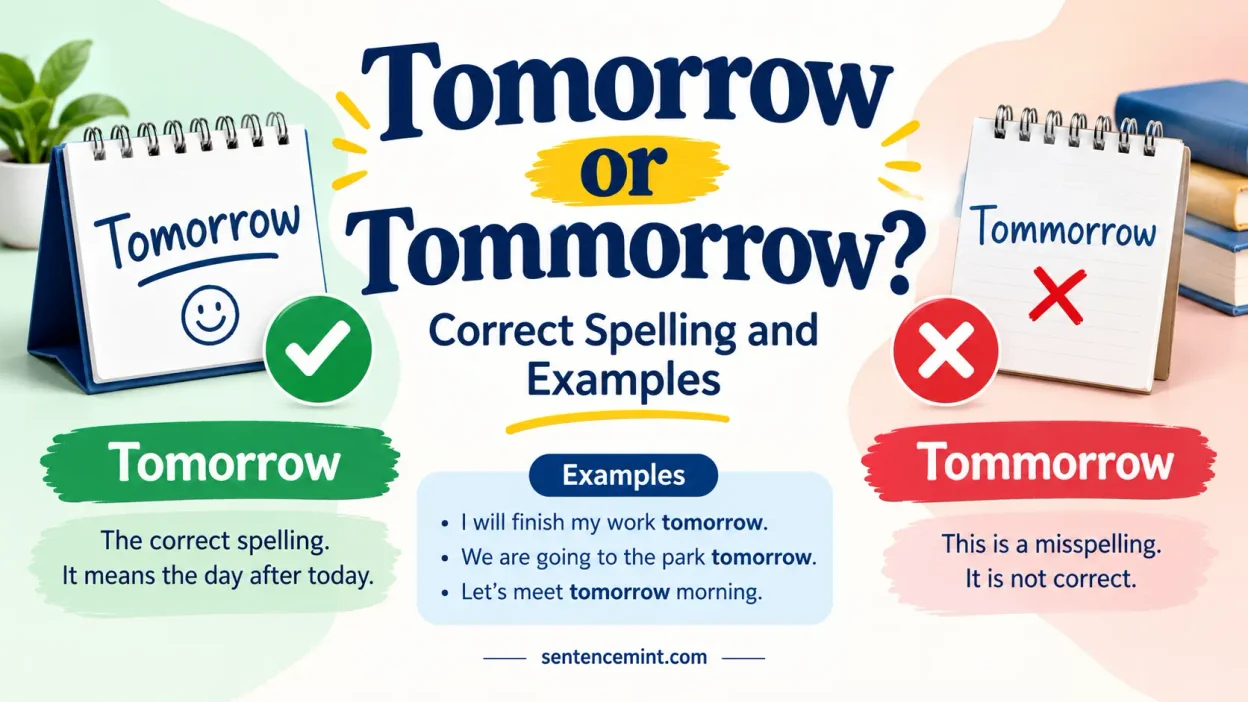
Featured Image Prompt: Create a premium 800×450 HD educational grammar blog featured image titled “Tomorrow or Tommorrow? Which Spelling Is Correct?” Display “TOMORROW” in bold green letters with a clear checkmark and “TOMMORROW” in red letters with a cross. Add a subtle calendar page showing the next day and a clean, modern editorial design. Use high contrast, balanced spacing, readable centered text, and a professional American English learning website aesthetic. Ensure all words are spelled correctly, fully visible, and free from watermarks or clutter.
Image Alt Text: Tomorrow or tommorrow spelling comparison showing the correct spelling of tomorrow
Tomorrow or Tommorrow: Which Spelling Is Correct?
Quick Answer: Tomorrow is the correct spelling. Tommorrow is incorrect because it contains an extra m. Use tomorrow when referring to the day after today, as in “I will finish my homework tomorrow.”
The words tomorrow and tommorrow look almost identical, so it is easy to make a spelling mistake when writing quickly. However, only one spelling is accepted in standard English.
If you are writing an email, completing a school assignment, sending a text message, or publishing an article, always use tomorrow. Remember that it has three syllables and contains one m followed by two r letters.
For example:
- Correct: I will call you tomorrow.
- Incorrect: I will call you tommorrow.
Understanding the correct spelling, meaning, and pronunciation will help you avoid this common mistake and write more confidently.
Tomorrow vs. Tommorrow: Quick Comparison
| Feature | Tomorrow | Tommorrow |
|---|---|---|
| Spelling status | Correct | Incorrect |
| Meaning | The day after today | No standard English meaning |
| Dictionary recognition | Standard English word | Misspelling of tomorrow |
| Correct example | See you tomorrow. | See you tommorrow. |
| Number of m letters | One | Two |
| Appropriate for formal writing | Yes | No |
The main rule is simple: write tomorrow with one m and two r’s.
What Does Tomorrow Mean?
Tomorrow is an English word that refers to the day after today. It can function as a noun or an adverb, depending on how it appears in a sentence.
People use it when talking about future plans, appointments, deadlines, events, and activities.
Examples:
- I have an English test tomorrow.
- We are going shopping tomorrow.
- Tomorrow is my birthday.
- She will send the documents tomorrow.
- The weather forecast says it may rain tomorrow.
In each example, tomorrow refers to the day immediately following the current day.
Tomorrow as a Noun
As a noun, tomorrow refers to the day after today.
Examples:
- Tomorrow is a holiday.
- We have a meeting scheduled for tomorrow.
- I am looking forward to tomorrow.
- Tomorrow will be a busy day.
In these sentences, tomorrow names a day or a future period.
Tomorrow as an Adverb
As an adverb, tomorrow tells the reader or listener when an action will happen.
Examples:
- I’ll finish the assignment tomorrow.
- They are leaving tomorrow.
- Please call me tomorrow.
- We will discuss the problem tomorrow.
Here, tomorrow modifies the action by identifying its time.
Why Is Tommorrow Incorrect?
Tommorrow is incorrect because standard English spells the word with one m, not two.
The mistake often happens because English spelling does not always match pronunciation. When people write quickly or rely on how a word sounds, they may accidentally repeat a letter.
Compare these spellings:
- Tomorrow: t-o-m-o-r-r-o-w
- Tommorrow: t-o-m-m-o-r-r-o-w
The incorrect version adds an extra m after the first one. Standard English dictionaries recognize tomorrow, not tommorrow, as the correct spelling.
Examples of correct usage include:
- I will complete the work tomorrow.
- Tomorrow morning, we will leave early.
- She hopes to visit her grandparents tomorrow.
Avoid tommorrow in schoolwork, business communication, online content, and professional documents.
How to Spell Tomorrow Correctly
One of the easiest ways to remember the spelling is to break the word into smaller parts.
T-O-M-O-R-R-O-W
Remember these three points:
- Start with T-O-M.
- Add O-R-R with two r’s.
- Finish with O-W.
The most important detail is that tomorrow has one m and two r’s.
You can also remember the phrase:
“Tomorrow has one M and two Rs.”
Repeat the phrase whenever you are unsure about the spelling. This simple technique can help you recall the correct letter pattern.
Tomorrow vs. Tommorrow in Example Sentences
The following examples show how to use the correct spelling naturally.
| Incorrect | Correct |
|---|---|
| I will meet you tommorrow. | I will meet you tomorrow. |
| We have an exam tommorrow. | We have an exam tomorrow. |
| She is traveling tommorrow morning. | She is traveling tomorrow morning. |
| Please finish this tommorrow. | Please finish this tomorrow. |
| Tommorrow will be a better day. | Tomorrow will be a better day. |
| The office opens tommorrow. | The office opens tomorrow. |
Notice that the correction is the same in every example. Replace tommorrow with tomorrow to make the spelling correct.
Common Phrases That Use Tomorrow
The word tomorrow appears in many everyday expressions. Learning these phrases can help you remember the spelling while improving your English.
Tomorrow Morning
This phrase refers to the morning of the next day.
Examples:
- I have a doctor’s appointment tomorrow morning.
- We will leave for the airport tomorrow morning.
- Please send me the report tomorrow morning.
Tomorrow Afternoon
This phrase refers to the afternoon of the next day.
Examples:
- The manager will call you tomorrow afternoon.
- We are meeting our clients tomorrow afternoon.
- I will finish the assignment tomorrow afternoon.
Tomorrow Night
This phrase refers to the night of the next day.
Examples:
- We are watching a movie tomorrow night.
- She will arrive tomorrow night.
- They plan to attend the event tomorrow night.
See You Tomorrow
This is a common expression used when saying goodbye to someone you expect to see the next day.
Examples:
- Thanks for your help. See you tomorrow!
- Have a good evening. See you tomorrow.
- I’ll bring your book tomorrow. See you tomorrow!
Practicing these familiar phrases helps reinforce the correct spelling.
Tomorrow vs. Today vs. Yesterday
Understanding related time words can make the meaning of tomorrow easier to remember.
| Word | Meaning | Example |
|---|---|---|
| Today | The current day | I have a meeting today. |
| Tomorrow | The day after today | I have a meeting tomorrow. |
| Yesterday | The day before today | I had a meeting yesterday. |
These three words describe different points in time.
For example, if today is Monday, yesterday was Sunday and tomorrow will be Tuesday.
Remember that tomorrow always refers to the day after the current day, regardless of the day of the week.
Why Do People Misspell Tomorrow?
There are several reasons people write tommorrow instead of tomorrow.
1. Typing too quickly: When people type quickly, they may accidentally repeat a letter.
2. Confusion about repeated letters: English contains many words with double letters, so writers sometimes assume that tomorrow needs two m’s.
3. Reliance on pronunciation: The way a word sounds does not always make its spelling obvious.
4. Autocomplete and typing habits: If a misspelling becomes a repeated typing habit, it may appear frequently in informal messages.
To prevent these mistakes, slow down when typing unfamiliar words, proofread your work, and use a spell-checking tool when necessary.
Tips to Remember the Correct Spelling
Use these practical techniques to remember tomorrow.
- Remember one M: The word begins with tom, not tomm.
- Remember two Rs: The middle of the word contains rr.
- Practice a sentence: Write “I will see you tomorrow” several times.
- Use a memory phrase: “One M, two Rs, and tomorrow is spelled right.”
- Proofread your writing: Check the word before sending an important message or publishing content.
Regular practice will make the correct spelling easier to recall.
Practice Quiz: Tomorrow or Tommorrow?
Choose the correct spelling to complete each sentence.
- I will finish my homework _____.
- We are going to visit our cousins _____.
- The school will announce the results _____.
- Can you call me _____ morning?
- _____ is another opportunity to learn something new.
- She plans to submit her application _____.
Options: Tomorrow / Tommorrow
Answers and Explanations
- Tomorrow — It refers to the day after today.
- Tomorrow — It identifies when the visit will happen.
- Tomorrow — It refers to a future day.
- Tomorrow — The correct phrase is “tomorrow morning.”
- Tomorrow — It is the subject of the sentence.
- Tomorrow — It identifies the day she plans to submit her application.
All six answers use tomorrow because tommorrow is not the standard spelling.
Frequently Asked Questions
Is it tomorrow or tommorrow?
Tomorrow is correct. Tommorrow is a common spelling mistake that adds an extra m.
Why is tomorrow spelled with one M?
The standard English spelling is tomorrow, with one m and two r’s. The spelling must be learned as a word because pronunciation alone may not reveal the correct letter pattern.
How many Rs are in tomorrow?
There are two Rs in tomorrow. The complete spelling is T-O-M-O-R-R-O-W.
Is tommorrow ever correct?
No. In standard English, tommorrow is a misspelling of tomorrow. Use tomorrow in formal and informal writing.
How can I remember the spelling of tomorrow?
Remember this phrase: “Tomorrow has one M and two Rs.” You can also practice writing a short sentence such as “See you tomorrow.”
What is the meaning of tomorrow?
Tomorrow means the day after today. For example, “I will visit my friend tomorrow” means the visit will take place on the next day.
Is tomorrow one word or two?
Tomorrow is one word. Do not write it as two separate words or add an extra letter.
Conclusion
The difference between tomorrow vs. tommorrow is straightforward: tomorrow is the correct spelling, while tommorrow is incorrect.
Use tomorrow when referring to the day after today, whether you are discussing appointments, schoolwork, business plans, or everyday activities. To remember the spelling, keep one rule in mind: tomorrow has one M and two Rs.
With a little practice and careful proofreading, you can avoid this common spelling mistake and write more confidently in English.
[…] following examples show the preferred spelling and an accepted […]