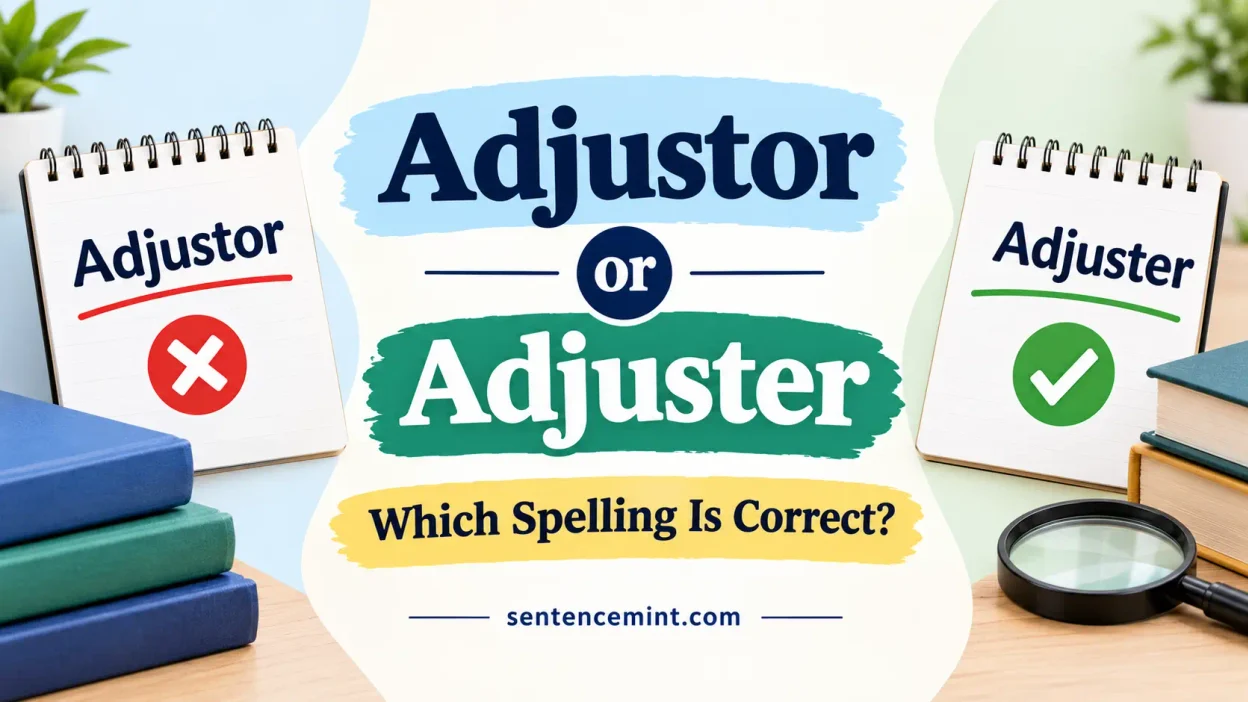
Featured Image Prompt: Create a premium 800×450 HD educational grammar blog featured image titled “Adjustor or Adjuster: Which Is Correct?” Show “ADJUSTER” in bold green text with a checkmark and “ADJUSTOR” in blue text labeled “Accepted Variant.” Include a subtle insurance document and magnifying glass to suggest claim evaluation. Use a clean, professional editorial style, strong contrast, balanced spacing, and a readable centered title. Ensure all text is spelled correctly, fully visible, and free from watermarks.
Image Alt Text: Adjustor or adjuster spelling comparison showing the preferred spelling adjuster
Adjustor or Adjuster: Which Spelling Is Correct?
Quick Answer: Both adjuster and adjustor are accepted English spellings, but adjuster is the preferred choice for most modern writing, particularly in American English and insurance-related content. Both words generally have the same meaning: a person or thing that adjusts something. For example, “The insurance adjuster inspected the damaged car.”
The difference between adjustor vs. adjuster is mainly about spelling preference, not meaning. Although you may encounter both forms in dictionaries, professional documents, and online articles, adjuster is the more familiar and widely used form.
If you are writing an article, business email, insurance report, or school assignment, adjuster is usually the safest choice. The alternative spelling adjustor is not necessarily wrong, but it is less common.
Let’s explore the meanings, examples, common mistakes, and usage rules to help you choose the right spelling.
Adjustor vs. Adjuster: Quick Comparison
| Feature | Adjuster | Adjustor |
|---|---|---|
| Spelling status | Correct and preferred | Correct variant |
| General meaning | A person or thing that adjusts | A person or thing that adjusts |
| American English | Common | Less common |
| Insurance terminology | Widely used | Accepted variant |
| Professional writing | Recommended | Less common |
| Best choice for most readers | Yes | Usually not |
The key takeaway is simple: use adjuster unless a specific organization, official title, or style guide requires adjustor.
What Does Adjuster Mean?
An adjuster is a person or device that adjusts, changes, or regulates something. In insurance, an adjuster is a professional who investigates claims and evaluates damage or losses to help determine the appropriate payment.
Examples:
- The insurance adjuster inspected the damaged vehicle.
- A claims adjuster reviewed the accident report.
- The technician used the adjuster to change the machine’s position.
- The company hired an experienced adjuster to evaluate the claim.
The exact meaning depends on the context. In insurance, the word usually refers to a professional. In a mechanical context, it may refer to a device used to change a setting or position.
Adjuster in Insurance
The phrase insurance adjuster is common in American English. These professionals investigate insurance claims, examine evidence, assess losses, and help determine how much an insurer should pay under a policy.
Examples:
- The insurance adjuster requested photographs of the damage.
- Our claims adjuster explained the next steps.
- The adjuster estimated the cost of repairing the roof.
- She contacted her insurance adjuster after the accident.
For articles about insurance careers, claims, or policies, insurance adjuster is the recommended wording.
Adjuster in Everyday and Technical English
The word also describes a device or component that changes a position, setting, or level.
Examples:
- The chair has a height adjuster.
- The mechanic replaced the brake adjuster.
- Use the strap adjuster to make the bag fit comfortably.
- The machine includes a tension adjuster.
These examples demonstrate that adjuster is not limited to insurance terminology.
What Does Adjustor Mean?
Adjustor is an accepted variant spelling of adjuster. It generally carries the same meaning and can refer to a person or thing that adjusts something.
Examples:
- The company hired an experienced claims adjustor.
- The document referred to an insurance adjustor.
- The equipment manual described an adjustment mechanism as an adjustor.
Although these examples are understandable, adjuster is generally the better choice for modern professional writing.
Major dictionaries recognize adjustor as an alternative form. Cambridge Dictionary lists adjustor as a variant in its entry for adjuster, and Collins Dictionary also recognizes the spelling. <Cite refs={[“turn819399search8″,”turn819399search6”]} />
Therefore, avoid assuming that adjustor is always a spelling error. It is a valid but less common alternative.
Why Are There Two Spellings?
The two forms developed through different noun endings in English.
The verb adjust describes changing something to make it more suitable, accurate, or effective. Adding the ending -er produces adjuster, while the alternative ending -or produces adjustor.
English uses both endings in words that describe people or things performing an action.
Examples include:
- Teach → teacher
- Inspect → inspector
- Adjust → adjuster
- Adjust → adjustor
The existence of both forms does not mean they have different meanings. In this case, the two spellings generally refer to the same role or function.
Over time, adjuster became the more common form in general and professional usage. That is why it is the preferred spelling for most writers today.
Adjuster vs. Adjustor in American English
In American English, adjuster is the more familiar spelling and the safer choice for general readers.
For example:
- Preferred: The insurance adjuster reviewed my claim.
- Accepted variant: The insurance adjustor reviewed my claim.
Both sentences communicate the same basic meaning. However, the first uses the more common spelling.
If you are creating U.S.-focused website content, use adjuster in your SEO title, headings, and main text when it fits the topic. You can mention adjustor naturally to explain the alternative spelling.
This approach keeps your writing clear while answering readers who search for either form.
Adjuster vs. Adjustor in British English
Both spellings also appear in British English. However, adjuster remains a safe general choice, including in insurance-related phrases.
For example:
- The loss adjuster examined the property.
- The adjuster reviewed the details of the claim.
The phrase loss adjuster is well established in British insurance terminology. Cambridge and Collins recognize the alternative spelling adjustor, so it is inaccurate to claim that one form belongs exclusively to American English and the other exclusively to British English. <Cite refs={[“turn819399search8″,”turn819399search7”]} />
When writing for an international audience, adjuster is generally the clearest default.
Adjustor or Adjuster: Example Sentences
The following examples show the preferred spelling and an accepted alternative.
| Example | Explanation |
|---|---|
| The insurance adjuster visited our home. | Adjuster is the preferred form. |
| The claims adjuster requested more evidence. | This is standard insurance terminology. |
| The equipment has a seat adjuster. | Here, it refers to a device. |
| The report referred to an insurance adjustor. | Adjustor is an accepted variant. |
| The company appointed a new claims adjuster. | This is the more common professional form. |
| The manual used the term adjustor. | The spelling may be retained when quoting a source. |
The main difference in these examples is spelling preference rather than meaning.
Common Mistakes to Avoid
Understanding the distinction can help you avoid several writing errors.
1. Assuming Adjustor Is Always Wrong
Incorrect assumption: “Adjustor is never a real English word.”
Correction: Adjustor is an accepted variant, although adjuster is preferred in most contexts.
2. Using Different Spellings Without a Reason
If you use adjuster throughout an article, avoid switching to adjustor without a reason.
For example:
Inconsistent: The adjuster inspected the damage. Later, the adjustor submitted a report.
Consistent: The adjuster inspected the damage. Later, the adjuster submitted a report.
Consistent spelling makes the article easier to read.
3. Choosing the Less Familiar Form for Insurance Content
Less preferred: Contact your insurance adjustor.
Recommended: Contact your insurance adjuster.
The first version is understandable, but the second is more familiar to most American readers.
4. Changing an Official Name or Quotation
If a company, document, or official title uses adjustor, do not automatically change it when reproducing the exact wording. Preserve the original spelling when accuracy requires it.
Which Spelling Should You Use?
Use adjuster in most situations, including:
- American English blog articles
- Insurance and claims content
- Professional emails and reports
- School assignments
- Business documents
- General educational writing
- SEO-focused articles for a broad audience
Use adjustor when you are quoting a source, following an established terminology choice, or reproducing an official name that uses that spelling.
For most everyday and professional writing, adjuster offers the clearest and most familiar option.
Frequently Asked Questions
Is adjustor or adjuster correct?
Both spellings are accepted, but adjuster is the preferred and more common form in modern English. Use it in most professional and general writing.
Is adjustor a real word?
Yes. Adjustor is a recognized variant spelling of adjuster. It generally has the same meaning, but it is less common.
Is insurance adjustor wrong?
Not necessarily. The spelling is accepted, but insurance adjuster is the more familiar and recommended phrase in American English.
What does an insurance adjuster do?
An insurance adjuster investigates claims, examines evidence, evaluates damage or losses, and helps determine the payment appropriate under an insurance policy.
Is adjuster American or British English?
Adjuster is used in both American and British English. It is a safe choice for general writing in either variety.
Do adjuster and adjustor have different meanings?
Usually, no. Both words can refer to a person or thing that adjusts something. The main difference is their spelling and frequency of use.
Which spelling should I use for SEO?
Use adjuster as your primary spelling for most U.S.-focused content. You can include adjustor naturally in a comparison section or FAQ to address readers searching for the alternative.
Conclusion
When comparing adjustor vs. adjuster, both spellings are accepted, but adjuster is the preferred choice for most modern English writing. It is widely used in American English, professional documents, and insurance terminology.
Adjustor remains a valid alternative, so it should not automatically be treated as a spelling error. However, if you want the clearest and most familiar wording for a broad audience, choose adjuster.
Remember this simple rule: adjuster is preferred; adjustor is an accepted variant.