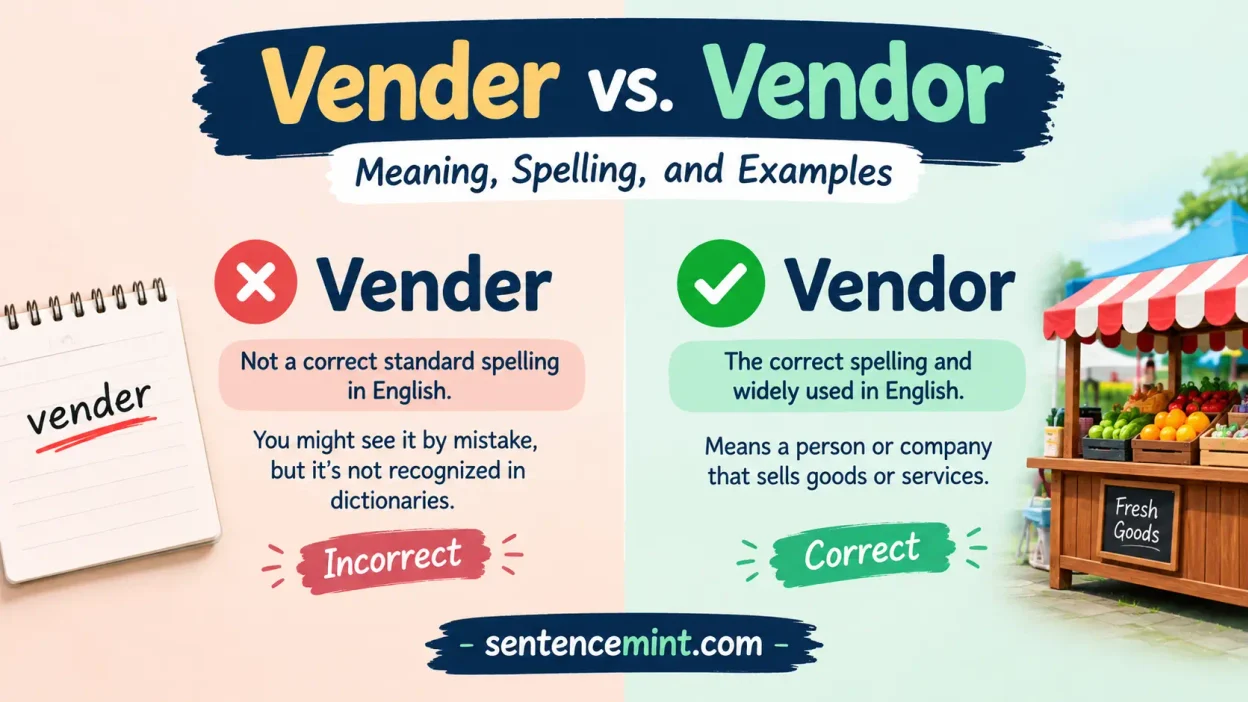
Featured Image Prompt: Create a professional 800×450 featured image for an American English grammar website. Show the words “VENDER vs. VENDOR” in large, perfectly spelled, centered typography. Highlight “VENDOR” as the standard spelling and present “VENDER” as a less common variant. Include a subtle business-themed background with a storefront, shopping bags, and a small vendor stall. Use a clean, modern editorial design, strong contrast, balanced spacing, and a premium educational look. Ensure all text is readable and fully inside the image, with no cropping, extra text, or watermark.
Image Alt Text: Vender vs. vendor spelling comparison showing the standard word vendor and its less common variant.
Quick Answer: Vender vs. Vendor
Vendor is the standard and preferred spelling in modern English. It means a person or business that sells goods or services. Vender is also recorded in some dictionaries as a less common spelling variant with the same basic meaning, but most writers should choose vendor for everyday, academic, and professional writing.
- Vendor: The standard spelling used in business and everyday English.
- Vender: A less common variant of vendor.
- Best choice: Use vendor in emails, invoices, contracts, reports, and other professional documents.
Vender vs. Vendor: What Is the Difference?
The main difference between vender and vendor is spelling preference, not meaning. Both forms can refer to a person or business that sells something, but vendor is much more widely used in modern English.
For example:
- Standard: The vendor delivered the office supplies on Monday.
- Less common variant: The vender delivered the office supplies on Monday.
The first sentence uses the spelling most readers expect. Although vender is a recognized variant, it may look like a spelling mistake to people who are unfamiliar with it.
If you are writing for an American audience, vendor is the safest and most natural choice.
What Does Vendor Mean?
A vendor is a person, company, or organization that sells products or provides services. Vendors operate in many industries, including retail, technology, food service, construction, and event planning.
The word can describe an individual selling goods directly to customers or a company supplying products and services to another business.
Examples of Vendor in a Sentence
- The food vendor sold fresh sandwiches outside the office.
- Our company selected a new vendor for its computer equipment.
- The wedding vendor arrived early to arrange the flowers.
- The online vendor shipped my order within two days.
- The manager contacted the software vendor about a technical problem.
- Several vendors displayed handmade products at the local market.
- The school invited a local vendor to provide lunch for the students.
- We compared three vendors before choosing a service provider.
In each sentence, vendor refers to a seller or a business that supplies goods or services.
Common Types of Vendors
The word vendor appears in several common expressions.
| Term | Meaning | Example |
|---|---|---|
| Street vendor | A person who sells goods in a public place | A street vendor sold hot dogs near the park. |
| Food vendor | A person or business selling food | The food vendor offered fresh lemonade. |
| Online vendor | A seller operating through the internet | The online vendor confirmed my order. |
| Software vendor | A company that sells or licenses software | The software vendor released an update. |
| Wedding vendor | A business providing wedding-related products or services | We hired a wedding vendor to arrange the flowers. |
| Wholesale vendor | A seller that supplies goods in large quantities | The wholesale vendor delivered boxes of supplies. |
| Third-party vendor | An outside business that provides products or services | The company hired a third-party vendor for technical support. |
These expressions use the standard spelling vendor.
What Does Vender Mean?
Vender is a less common spelling variant of vendor. Some dictionaries, including Collins English Dictionary, recognize it as an alternative spelling in American English. It has the same basic meaning: a person or business that sells goods or services.
For example:
- The vender offered fresh fruit at the market.
- The company contacted the vender about its order.
These sentences illustrate the variant spelling, but vendor is the more familiar and widely preferred form.
You may encounter vender in certain publications, older texts, or writing that follows a particular editorial style. Its existence does not make it the best choice for general writing.
Should You Use Vender in Modern Writing?
In most cases, no. Although vender is a documented variant, using vendor will make your writing more consistent with standard modern usage.
Choose vendor when writing:
- Business emails and reports
- Purchase orders and invoices
- Contracts and supplier agreements
- School assignments and essays
- Website content and product descriptions
- Professional documents and presentations
Use vender only when you have a specific reason to follow that spelling, such as reproducing a quotation or adhering to an established publication’s house style.
Vender vs. Vendor: Comparison Table
The following table summarizes the difference between the two spellings.
| Feature | Vendor | Vender |
|---|---|---|
| Standard modern spelling | Yes | Less common variant |
| Basic meaning | A person or business that sells goods or services | The same basic meaning |
| Common in business writing | Yes | Rare |
| Suitable for general American English | Yes | Usually avoid |
| Use in professional documents | Recommended | Generally not recommended |
| Plural form | Vendors | Venders |
| Best choice for most writers | Yes | No |
The key point is simple: the two forms have the same basic meaning, but vendor is the preferred spelling in most modern contexts.
Why Do People Confuse Vender and Vendor?
People confuse these words because they look and sound almost identical. Only one letter changes, and both spellings may seem reasonable.
Several factors contribute to the confusion.
1. English Uses Different Word Endings
English has many nouns ending in -er and -or. Both endings can identify a person who performs an action.
For example:
- Teacher
- Writer
- Actor
- Editor
- Vendor
Because vender follows a familiar spelling pattern, writers may assume it is the usual form. However, English spelling does not follow one simple rule for every word. Familiar patterns do not always identify the standard spelling.
2. Both Spellings Are Recognized
Some dictionaries list vender as a variant of vendor. This makes the question more complicated than a simple comparison between a correct spelling and an entirely invented word.
However, dictionary recognition does not mean that two spellings are equally common or equally suitable in professional writing.
3. The Words Sound Alike
In ordinary speech, vendor and vender are generally pronounced the same way or very similarly. Hearing the word therefore may not help you identify which spelling to use.
The easiest solution is to remember the standard written form: vendor.
Is Vendor Correct in American and British English?
Yes. Vendor is the standard spelling in both American and British English.
This is not a typical American-versus-British spelling difference such as color and colour. Writers in both varieties of English commonly use vendor to describe a seller or supplier.
Vender is recorded as a less common alternative in some dictionaries, but it is not the usual spelling for general business communication in either variety.
Consider these examples:
- American English: The vendor sent us a revised invoice.
- British English: The vendor supplied the equipment on time.
Both sentences use the standard spelling.
If your audience includes readers from different English-speaking countries, vendor remains the most practical choice.
How to Remember the Correct Spelling
A simple memory trick can help you avoid confusion.
Remember “Vendor” for Business
Associate vendor with common business phrases such as:
- Vendor agreement
- Vendor management
- Vendor payment
- Vendor invoice
- Vendor list
- Vendor relationship
These expressions appear regularly in professional communication. Remembering them as complete phrases can make the spelling easier to recall.
Check the Ending Before Publishing
When writing about a seller, pause briefly to check the final letters. The standard form is v-e-n-d-o-r.
For example:
Incorrect for standard usage: We approved the new vender.
Preferred: We approved the new vendor.
You do not need to memorize a complicated grammar rule. Remembering the preferred spelling is usually enough.
Common Mistakes with Vender and Vendor
Even small spelling choices can affect the clarity and polish of professional writing. These examples show how to handle common situations.
Mistake 1: Using Vender in a Business Email
Less preferred: Please contact the vender about the delivery.
Recommended: Please contact the vendor about the delivery.
The second version uses the standard spelling expected in most workplaces.
Mistake 2: Assuming Vender Has a Different Meaning
Vender is not generally a separate word with a different meaning from vendor. When used as a spelling variant, it refers to the same basic concept.
Example: The vendor sells office furniture.
The sentence identifies a seller. Changing vendor to vender does not normally change that meaning.
Mistake 3: Treating Vender as a British Spelling
Vendor is standard in both American and British English. The difference is not a straightforward regional spelling distinction.
Recommended: Use vendor for a general English-speaking audience.
Mistake 4: Changing the Spelling Within One Document
Using vendor in one paragraph and vender in another can make a document look inconsistent.
Better approach: Choose vendor throughout your document unless you need to reproduce a source that uses the alternative spelling.
Mistake 5: Forgetting the Plural Form
The standard plural of vendor is vendors.
Incorrect for standard usage: The vender delivered their products.
Recommended: The vendors delivered their products.
The plural follows the usual pattern of adding -s to vendor.
Vender vs. Vendor: Practice Quiz
Test your understanding by choosing the better spelling for each sentence.
1. The company hired a new ______ to manage its website.
- A. vender
- B. vendor
2. The food ______ sold fresh fruit at the farmers’ market.
- A. vendor
- B. vender
3. We need to review the ______ agreement before signing it.
- A. vender
- B. vendor
4. Several ______ attended the business conference.
- A. vendors
- B. venders
5. Which spelling should you generally use in a professional email?
- A. Vender
- B. Vendor
Quiz Answers
- B. Vendor — This is the standard spelling.
- A. Vendor — Vendor is preferred for a person selling food.
- B. Vendor — Vendor agreement is a standard business expression.
- A. Vendors — This is the standard plural form.
- B. Vendor — It is the most widely accepted choice in modern professional writing.
Frequently Asked Questions
1. Is vender or vendor correct?
Vendor is the standard and preferred spelling in modern English. Vender is a less common variant recorded in some dictionaries. For most writing, choose vendor.
2. Is vender a real word?
Yes. Some dictionaries recognize vender as a variant spelling of vendor. It has the same basic meaning but is much less common in everyday and professional writing.
3. What does vendor mean?
A vendor is a person, company, or organization that sells goods or provides services. Examples include a food vendor, a street vendor, and a software vendor.
4. Is vendor correct in American English?
Yes. Vendor is the standard spelling in American English. Although vender is also recorded as a variant, vendor is the form most writers should use.
5. Is vendor correct in British English?
Yes. Vendor is commonly used in British English as well as American English. It is not a spelling that normally changes between these varieties.
6. Do vender and vendor mean the same thing?
Generally, yes. When vender is used as a spelling variant, it has the same basic meaning as vendor: a person or business that sells something. The main difference is how commonly each spelling is used.
7. What is the plural of vendor?
The standard plural is vendors.
Example: The company works with several vendors to obtain its supplies.
8. What is the difference between a vendor and a supplier?
A vendor sells goods or services, while a supplier provides goods or materials to customers or businesses. The terms can overlap, and businesses sometimes use them interchangeably. Vendor is especially common in retail, procurement, technology, and service-related contexts.
Conclusion
When choosing between vender and vendor, vendor is the best choice for almost all modern writing. It is the standard spelling used in American and British English for a person or business that sells goods or services.
Vender is not simply an invented spelling; some dictionaries recognize it as a less common variant. However, it is much less familiar to most readers and is rarely the best option for professional communication.