
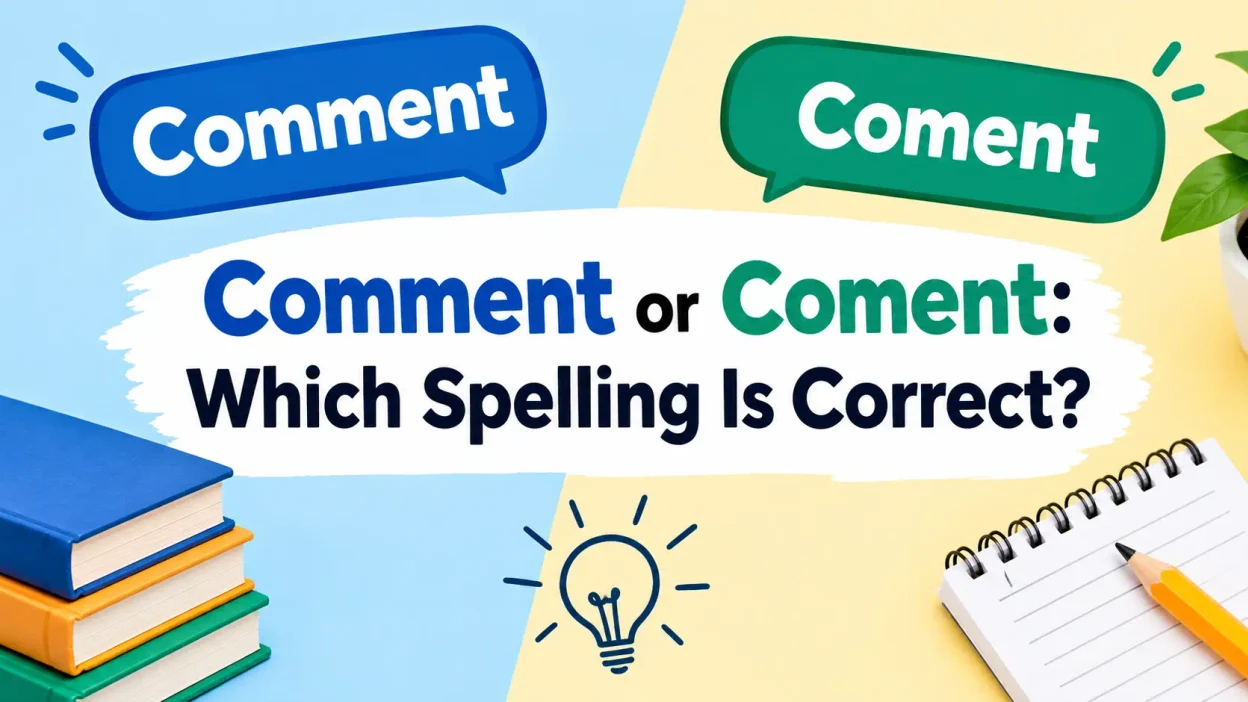
Featured Image Prompt
Create a clean 800×450 educational spelling graphic showing “COMMENT ✓” and “COMENT ✗” in large centered typography, with a modern speech bubble and writing context in the background, professional American English learning style, balanced composition, sharp readable text, no empty areas, no unnecessary text.
Image Alt Text
Educational graphic showing the correct spelling comment and incorrect spelling coment.
Comment or Coment: Which Is Correct?
If you are wondering whether the correct spelling is comment or coment, the answer is comment.
Comment is the standard English spelling. It can be used as both a noun and a verb. As a noun, it refers to something someone says or writes, often expressing an opinion. As a verb, it means to express an opinion or make a remark about something. Cambridge Dictionary
Coment is not the standard English spelling of this word. If you are writing in American English, use comment with two m’s.
Quick Answer
Comment is the correct spelling. Coment is a misspelling when you mean a remark, opinion, or statement. For example, write “She made a helpful comment” and “He commented on the article,” not “She made a helpful coment.”
Comment or Coment: Which Spelling Is Correct?
The correct spelling is:
Comment ✓
The incorrect spelling is:
Coment ✗
The main spelling difference is the second m.
| Spelling | Correct? | Meaning |
|---|---|---|
| comment | ✓ | A remark, opinion, or statement; also a verb |
| coment | ✗ | Standard English misspelling |
Examples
Correct:
- Please leave a comment below.
- She made a positive comment about my work.
- He commented on the new policy.
Incorrect:
- Please leave a coment below.
- She made a positive coment about my work.
- He comented on the new policy.
The standard spelling always uses double m:
c-o-m-m-e-n-t
What Does Comment Mean?
Comment has two common grammatical roles: it can be a noun or a verb.
As a noun, a comment is something someone says or writes that expresses an opinion, observation, or reaction. Cambridge gives examples such as comments made about someone’s work or comments given to the press. Cambridge Dictionary
For example:
- Her comment was helpful.
- I read several comments about the movie.
- The teacher left a comment on my essay.
As a verb, comment means to express an opinion or make a remark.
- She commented on my new haircut.
- He commented that the book was interesting.
- The manager refused to comment.
Both uses are common in American English. Cambridge Dictionary
Why Is Comment Spelled With Two Ms?
The standard spelling is comment, with two m’s:
C-O-M-M-E-N-T
A common spelling mistake is to write coment, probably because the second m can be easy to overlook when writing or typing quickly.
The safest way to remember it is:
com + ment = comment
Think of the word as having a small visual checkpoint:
CO + MM + ENT
That double m belongs in the standard spelling.
Is Coment a Word?
Coment is not the standard English spelling of comment.
If you want to refer to an opinion, remark, or statement, use comment.
For example:
Correct:
“That’s an interesting comment.”
Incorrect:
“That’s an interesting coment.”
The same applies when the word is used as a verb:
Correct:
“She commented on the situation.”
Incorrect:
“She comented on the situation.”
How Do You Pronounce Comment?
In American English, comment is pronounced:
/ˈkɑː.ment/
A simple pronunciation guide is:
KAH-ment
Cambridge lists the U.S. pronunciation as /ˈkɑː.ment/. Cambridge Dictionary
The word has two syllables, with the stress on the first syllable:
COM-ment
The pronunciation is the same whether comment is being used as a noun or a verb in ordinary American English.
Is Comment a Noun or a Verb?
Comment can be both a noun and a verb.
Comment as a Noun
A noun refers to a remark, opinion, or statement.
Examples:
- That was an unnecessary comment.
- I left a comment on her post.
- His comment made everyone laugh.
- The article received hundreds of comments.
Comment as a Verb
As a verb, comment means to express an opinion or make a remark.
Examples:
- She commented on the photo.
- He commented that the food was excellent.
- The teacher commented on my writing.
- The company declined to comment.
Cambridge identifies comment as both a noun and a verb. Cambridge Dictionary
Comment in Social Media and Online Writing
Comment is especially common in online communication.
On websites and social media platforms, a comment is usually a written response posted below a video, article, photo, or other piece of content.
Examples:
- I left a comment on the video.
- She replied to my comment.
- The post received hundreds of comments.
- Please share your thoughts in the comments.
The expression comment section is also standard English. Cambridge lists comment section as a common word combination. Cambridge Dictionary
Comment vs. Remark
Comment and remark can have similar meanings, but they are not always interchangeable in every situation.
A comment can be something said or written to express an opinion or reaction.
A remark can also mean something someone says, especially a particular statement made in conversation.
For example:
- She made a helpful comment about my essay.
- He made a funny remark during the meeting.
Both words can refer to something someone says, but the best choice depends on the context.
Common Mistakes With Comment
Mistake 1: Writing Coment
Incorrect:
“I posted a coment.”
Correct:
“I posted a comment.”
Remember the double m.
Mistake 2: Writing Comented
When comment becomes a past-tense verb, the spelling changes to commented, not comented.
Incorrect:
“He comented on the article.”
Correct:
“He commented on the article.”
The double m remains, and -ed is added:
comment → commented
Mistake 3: Writing Comentary
Another related spelling mistake is leaving out an m in commentary.
The correct spelling is:
commentary ✓
Not:
comentary ✗
For example:
The sports commentator provided excellent commentary.
Comment, Comments, Commented, and Commenting
The word has several common forms.
| Form | Use | Example |
|---|---|---|
| comment | Noun or base verb | Leave a comment. |
| comments | Plural noun or third-person verb | She comments often. |
| commented | Past-tense verb | He commented yesterday. |
| commenting | -ing form | She is commenting on the post. |
Notice that all these forms keep the double m:
comment
comments
commented
commenting
When Should You Use Comment?
Use comment when you are talking about a remark, opinion, observation, or response.
It works in both casual and formal English.
Casual
“I liked your comment.”
Academic
“The professor added several comments to the student’s paper.”
Professional
“The company declined to comment on the report.”
Online
“You can leave a comment below the article.”
The word is not limited to casual conversation. It is widely used across everyday, academic, professional, and online contexts. Cambridge Dictionary
Is Comment Formal or Informal?
Comment is a neutral English word.
It can be used in casual conversation as well as formal writing.
For example:
Casual:
“That’s a funny comment.”
Professional:
“We appreciate your comments on the proposal.”
Formal:
“The spokesperson declined to comment on the matter.”
The tone comes largely from the surrounding sentence rather than from the word comment itself.
Examples of Comment in Sentences
Here are some natural examples:
- She made a positive comment about the new restaurant.
- Please leave a comment below.
- I don’t have any comment on the situation.
- His comment was misunderstood.
- The teacher wrote several comments on my paper.
- She commented on my new haircut.
- He commented that the movie was too long.
- The company refused to comment on the report.
- I read your comment this morning.
- Many people commented on the video.
These examples show how comment works naturally as both a noun and a verb.
A Simple Trick to Remember the Spelling
If you often write coment by mistake, remember:
COMMENT = two M’s
You can break the word visually into:
COM + MENT
The important part is:
MM
So:
comment ✓
coment ✗
A quick memory sentence is:
“My comment has two M’s.”
That can help you remember the spelling when writing quickly.
Frequently Asked Questions
Is it comment or coment?
Comment is the correct spelling. Coment is a misspelling in standard English.
What does comment mean?
As a noun, comment means something someone says or writes that expresses an opinion, observation, or reaction. As a verb, it means to express an opinion or make a remark. Cambridge Dictionary
Is comment a noun or a verb?
It can be both a noun and a verb. You can make a comment or comment on something. Cambridge Dictionary
How do you spell comment correctly?
Spell it C-O-M-M-E-N-T. The word contains two m’s.
How do you pronounce comment in American English?
In American English, comment is pronounced approximately KAH-ment, with the stress on the first syllable. The U.S. pronunciation is listed as /ˈkɑː.ment/. Cambridge Dictionary
Is coment a correct English word?
Not when you mean the standard English word comment. Use comment for a remark, opinion, or written response.
What is the past tense of comment?
The past tense is commented.
Example:
She commented on my post yesterday.
The spelling keeps the double m.
Conclusion
When choosing between comment or coment, always use comment. The standard spelling contains two m’s: C-O-M-M-E-N-T.
Comment can be a noun meaning a remark or opinion, or a verb meaning to express an opinion or make a remark. It is a neutral word used in everyday conversation, professional writing, academic contexts, and online communication. Cambridge Dictionary



[…] correct spelling has one […]