
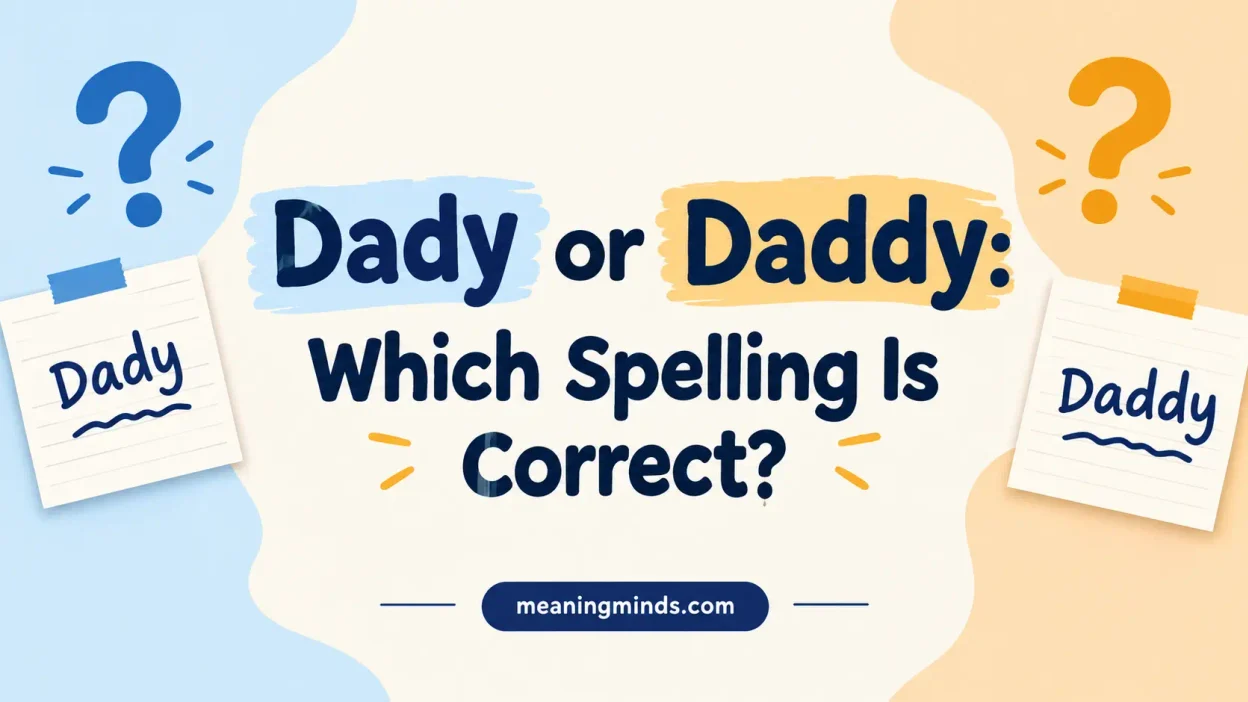
Featured Image Prompt
Create a clean 800×450 educational spelling image showing “DADY ❌” and “DADDY ✓” prominently, with a warm father-and-child scene in the background, modern American English learning style, balanced composition, sharp readable typography, no empty areas, no unnecessary text.
Image Alt Text
Educational graphic comparing the incorrect spelling dady with the correct spelling daddy.
Dady or Daddy: Which Is Correct?
If you are unsure whether to write dady or daddy, the correct spelling in standard English is daddy. The word has two d’s in the middle: d-a-d-d-y.
Daddy is an informal word for father, especially one commonly used by children. It can also be used affectionately as a form of address. The spelling dady is not the standard English spelling of this word and is normally considered a misspelling. Cambridge Dictionary
Quick Answer
Daddy is the correct spelling. Dady is incorrect when you mean “father.” In American English, daddy is pronounced /ˈdædi/ and is an informal, affectionate word for a father, especially when used by or with children. Cambridge Dictionary
Dady or Daddy: Which Spelling Is Correct?
The correct spelling is:
Daddy ✓
The incorrect spelling is:
Dady ✗
The difference is one letter. Daddy contains a double d before the final y.
| Spelling | Correct? | Meaning |
|---|---|---|
| daddy | ✓ Yes | Informal word for father |
| dady | ✗ No | Misspelling of daddy |
For example:
- My daddy is picking me up from school. ✓
- I called my daddy after work. ✓
- My dady is picking me up from school. ✗
If you are writing about someone’s father in normal English, use daddy, not dady.
What Does Daddy Mean?
Daddy is an informal noun meaning father. It is especially associated with children’s speech, although adults may also use it when addressing or referring to their father. Cambridge and Oxford both identify daddy as a word used especially by or with young children to mean “father.” Cambridge Dictionary
Examples:
- Daddy, can you help me?
- My daddy taught me how to ride a bike.
- The little girl ran to her daddy.
- Daddy is making dinner tonight.
The word can sound warm, affectionate, or childlike depending on the speaker and situation.
Why Is Daddy Spelled With Two Ds?
The standard spelling is daddy, not dady.
The word is formed from dad with the diminutive ending -y, giving daddy. Oxford lists its origin as early 16th century, from dad + -y. Oxford Learner’s Dictionaries
The spelling therefore keeps the double d:
dad + y → daddy
You should not remove one of the d’s and write dady.
This is similar to other familiar English words where a consonant is doubled in the spelling. The important point for learners is simple: memorize the standard spelling as daddy.
How Do You Pronounce Daddy?
In American English, daddy is pronounced:
/ˈdædi/
A simple pronunciation guide is:
DAD-ee
The stress falls on the first syllable. Cambridge gives the U.S. pronunciation as /ˈdæd.i/. Cambridge Dictionary
The pronunciation does not change simply because the word has two d’s in the middle.
Example
Daddy, where are you?
You pronounce it approximately like:
DAD-ee, where are you?
Is Daddy Formal or Informal?
Daddy is informal.
It is most commonly associated with family conversation and children’s speech. In formal writing, father is generally more appropriate.
Compare:
- My daddy works at a hospital.
Informal and personal. - My father works at a hospital.
More neutral. - The patient’s father arrived at the hospital.
Appropriate in a formal or professional context.
This does not mean daddy is grammatically wrong. It simply has a different tone and social context.
Daddy vs. Father
Both words refer to a person’s male parent, but they are not identical in tone.
Daddy is informal and often affectionate.
Father is neutral and can be formal.
For example:
My daddy used to read me stories.
This sounds personal and affectionate.
My father was born in Texas.
This sounds neutral and is suitable for many formal contexts.
The choice depends on the relationship, audience, and setting.
When Should You Use Daddy?
Use daddy when the context is informal, personal, or child-centered.
It is especially natural when:
- a child is talking about or addressing their father
- a parent is speaking with a young child
- someone is using an affectionate family term
- a personal story uses family language
Examples:
“Daddy, look at this!”
“Her daddy picked her up after school.”
“I remember my daddy teaching me to fish.”
In each example, daddy has a familiar or affectionate tone.
When Should You Use Father Instead?
Use father when you want a more neutral or formal word.
For example:
Formal:
“My father attended the meeting.”
Neutral:
“My father lives in California.”
Informal:
“My daddy lives in California.”
All three can be grammatically correct, but the tone is different.
In a formal report, application, academic paper, or professional document, father will usually sound more appropriate than daddy.
Is Dady Ever Correct?
If you mean father, dady is not the standard spelling.
For ordinary English writing, use daddy.
You might encounter Dady as a proper name or surname, but that is a different use and should not be confused with the common noun daddy. A name does not make dady an alternative spelling of the word meaning “father.” Wiktionary
So:
My daddy is here. ✓
My dady is here. ✗
Common Mistakes With Daddy
Mistake 1: Writing Dady
Incorrect:
“My dady called me yesterday.”
Correct:
“My daddy called me yesterday.”
The standard spelling has two d’s before the final y.
Mistake 2: Using Daddy in a Formal Context
Less suitable:
“My daddy is the owner of the company,” in a formal business report.
Better:
“My father is the owner of the company.”
The first sentence is not grammatically incorrect, but father better fits formal writing.
Mistake 3: Confusing Spelling With Pronunciation
Some learners may assume that because the second d is not strongly noticeable in speech, it can be left out in writing.
That is not how standard spelling works. The word is spelled daddy, regardless of how clearly each consonant is heard.
Daddy in American English
In the United States, daddy is a familiar term for a father and is especially common in speech involving young children. American dictionaries and language references classify it as an informal term related to dad or father. Cambridge Dictionary
For adults, usage varies by family and personal preference. Some adults continue to call their father Daddy, while others use Dad, Papa, or Father.
There is no grammatical rule requiring adults to stop using Daddy. It is mainly a matter of family usage and tone.
Can Daddy Have Other Meanings?
Yes. Although father is the main everyday meaning, daddy can appear in other expressions and slang.
For example, sugar daddy has a separate slang meaning referring to a person who provides money or financial support to a younger partner or companion. Dictionary.com
The meaning of daddy can therefore depend on the surrounding words.
Compare:
“My daddy is coming to pick me up.”
Here, daddy means father.
“He is her sugar daddy.”
Here, daddy is part of a separate slang expression.
You should not assume that every use of daddy refers literally to someone’s father.
Is Daddy a Noun?
Yes. Daddy is primarily a noun.
Examples:
- Daddy is home.
- I called my daddy.
- Her daddy bought her a bicycle.
The plural form is daddies. Scrabble Dictionary
Example:
The children talked about their daddies.
Daddy vs. Dad
Dad and daddy can both mean “father,” but their tone differs.
Dad is a common informal word for father and is widely used by adults.
Daddy is more affectionate, child-oriented, or familiar.
Examples:
- My dad is at work.
- My daddy is at work.
Both can be correct. The second sentence generally sounds more childlike or affectionate.
Examples of Daddy in Sentences
Here are some natural examples:
- Daddy, can you read me a story?
- Her daddy picked her up from school.
- My daddy taught me how to swim.
- The baby reached for her daddy.
- I called my daddy on his birthday.
- Daddy is making breakfast.
- She wanted to show her daddy the drawing.
- My dad and I went fishing, but I still called him Daddy when I was little.
These examples show why daddy is usually associated with informal and family situations.
A Simple Trick to Remember the Spelling
Remember:
DAD + DY = DADDY
The word dad already ends with d. When the -y ending is added, the standard spelling is:
DADDY
A useful visual reminder is:
DAD → DADDY
Not:
DAD → DADY
Frequently Asked Questions
Is it dady or daddy?
Daddy is the correct spelling when you mean “father.” Dady is normally a misspelling.
What does daddy mean?
Daddy is an informal word for father, especially one used by or with young children. It can also be an affectionate way of addressing or referring to one’s father. Cambridge Dictionary
Is daddy a formal word?
No. Daddy is informal and familiar. Father is generally better for formal writing and professional contexts.
How do you pronounce daddy?
In American English, daddy is pronounced /ˈdædi/, approximately “DAD-ee.” Cambridge Dictionary
Is dady a word?
Dady is not the standard spelling of the English word meaning “father.” If you mean the family term, write daddy. A capitalized Dady may appear as a surname or proper name, which is a separate use. Wiktionary
What is the plural of daddy?
The plural is daddies.
Example:
The children talked about their daddies. Oxford Learner’s Dictionaries
Is daddy the same as dad?
They can both refer to a father, but daddy is generally more affectionate or child-oriented, while dad is a common informal term used by both children and adults.
Conclusion
If you are choosing between dady or daddy, use daddy. It is the standard English spelling for the informal word meaning father.
Daddy is especially common in children’s and family language, while father is more neutral or formal. The spelling dady should not be used when you mean “father.”
[…] is the correct spelling. Coment is a misspelling when you mean a remark, opinion, or statement. For example, write “She […]