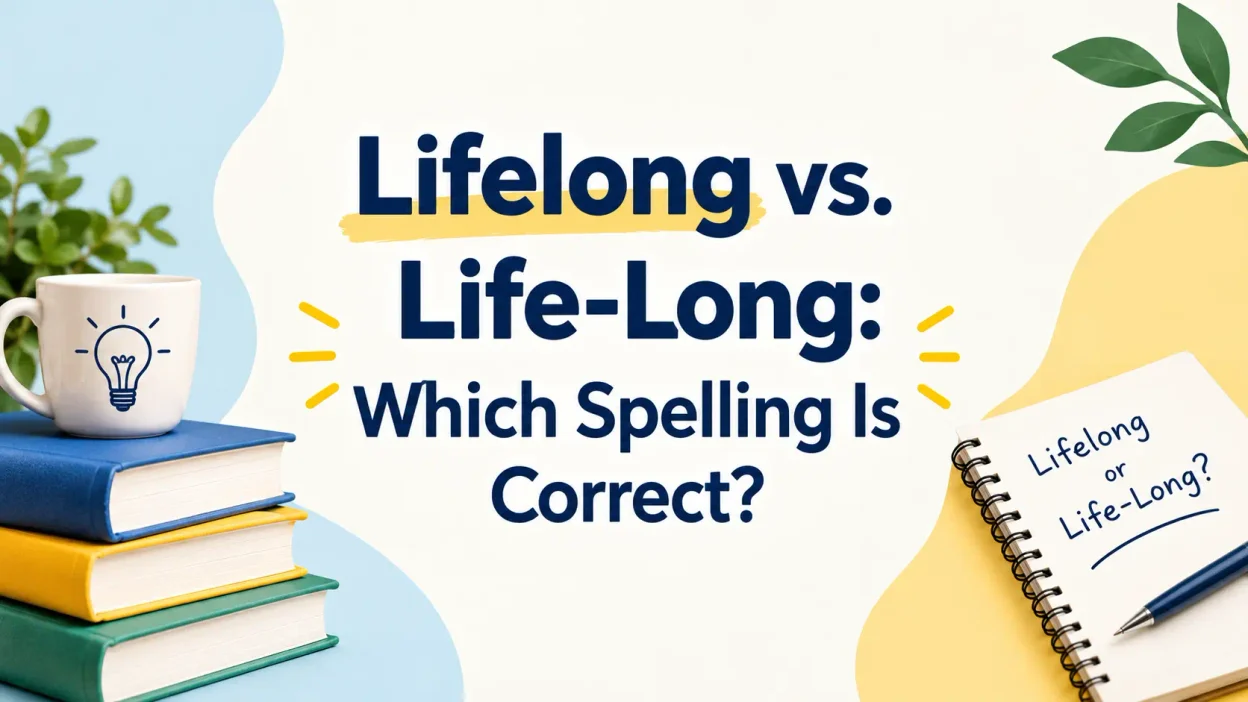
Featured Image Prompt: Create an 800×450 HD featured image for an American English grammar website. Display the title “LIFELONG vs. LIFE-LONG” in large, perfectly spelled, centered typography. Highlight “LIFELONG” as the preferred modern American English spelling. Use a clean educational design with subtle visual elements representing learning, personal growth, books, and the passage of time. Choose a professional color palette, strong contrast, and balanced spacing. Keep all text readable and fully inside the image. No cropped text, extra wording, or watermark.
Image Alt Text: Lifelong vs. life-long spelling comparison showing lifelong as the preferred spelling in modern English.
Quick Answer: Lifelong vs. Life-Long
Lifelong is the preferred spelling in modern American English. It means lasting throughout a person’s life or continuing for a lifetime. The hyphenated form life-long is also found in English, but it is less common in contemporary general writing. For school assignments, professional documents, website content, and everyday American English, use lifelong as one word.
- Lifelong: The preferred modern spelling.
- Life-long: A less common hyphenated variant.
- Meaning: Lasting throughout life.
- Best choice for American English: Lifelong.
What Does Lifelong Mean?
The word lifelong is an adjective that describes something that continues throughout a person’s life. It can refer to relationships, interests, learning, habits, commitments, or personal experiences that last for many years or potentially for an entire lifetime.
For example, a lifelong friendship is a friendship that lasts throughout life. A lifelong learner is someone who continues learning at different stages of life.
Examples of Lifelong in a Sentence
- Reading has been a lifelong passion of hers.
- They developed a lifelong friendship in elementary school.
- My grandfather was a lifelong supporter of the local team.
- She believes that education should be a lifelong process.
- He has a lifelong interest in American history.
- The experience created a lifelong memory for the family.
- Their lifelong commitment to helping others inspired the community.
- She hopes to remain a lifelong learner.
In each example, lifelong describes something that continues or remains important throughout a person’s life.
What Does Life-Long Mean?
Life-long is a hyphenated spelling variant of lifelong. It carries the same basic meaning: lasting throughout life.
For example:
- She has a life-long interest in music.
- They formed a life-long friendship.
- He believes in life-long learning.
These sentences communicate the same ideas as their one-word versions:
- She has a lifelong interest in music.
- They formed a lifelong friendship.
- He believes in lifelong learning.
The main difference is spelling, not meaning. However, lifelong is the more familiar and preferred form in modern American English.
Is Life-Long Incorrect?
No. Life-long is not necessarily incorrect. The hyphenated form appears in published English, and some writers or editorial styles may prefer it. However, many modern dictionaries and publications use lifelong as the standard form.
If you are writing for a general American audience, lifelong is usually the safest option. It is concise, widely recognized, and consistent with contemporary usage.
Lifelong vs. Life-Long: Comparison Table
| Feature | Lifelong | Life-long |
|---|---|---|
| Spelling | One word | Hyphenated |
| Meaning | Lasting throughout life | Lasting throughout life |
| Modern American English | Preferred form | Less common variant |
| Meaning difference | None in ordinary usage | None in ordinary usage |
| Common phrases | Lifelong learning, lifelong friend | Life-long learning, life-long friend |
| Suitable for professional writing | Yes | Acceptable, depending on style |
| Best choice for most U.S. writers | Yes | Usually not necessary |
The two spellings generally communicate the same meaning. For consistency and readability, choose lifelong unless a specific style guide requires the hyphenated form.
Is Lifelong One Word or Two?
Lifelong is written as one word, without a space or hyphen.
Correct examples:
- Lifelong learning
- Lifelong friendship
- Lifelong passion
- Lifelong commitment
- Lifelong ambition
- Lifelong interest
- Lifelong habit
These phrases are common in education, personal development, professional writing, and everyday conversation.
Compare the following sentences:
Preferred: The course encouraged lifelong learning.
Less common: The course encouraged life-long learning.
Incorrect as a standard compound spelling: The course encouraged life long learning.
The final example separates the words without a hyphen. Although separate words can appear in other grammatical constructions, lifelong should normally remain one word when it means lasting throughout life.
Lifelong vs. Life-Long in American English
In American English, lifelong is the standard and more widely preferred spelling. It appears in dictionaries, educational materials, news writing, and professional publications.
Consider these examples:
- The organization promotes lifelong learning.
- She has a lifelong passion for science.
- They maintained a lifelong friendship.
- He made a lifelong commitment to public service.
The one-word spelling works naturally in each sentence.
Although life-long is understandable and sometimes used, there is usually no need to add a hyphen. When writing articles, reports, essays, or business documents for American readers, using lifelong helps maintain a consistent modern style.
Lifelong vs. Life-Long in British English
Lifelong is also widely used in British English. The hyphenated form life-long can appear in British publications, but it is not necessary simply because the audience is British.
For example:
- American English: The program supports lifelong learning.
- British English: The programme supports lifelong learning.
Notice that the spelling of the word lifelong does not need to change. The difference between program and programme is a familiar regional spelling distinction, but lifelong is commonly written as one word in both varieties of English.
For an international audience, lifelong is a practical and widely recognized choice.
Common Phrases That Use Lifelong
The word lifelong appears in many expressions. Learning these phrases can help you remember the correct spelling and use it naturally.
| Phrase | Meaning | Example |
|---|---|---|
| Lifelong learning | Continuing to learn throughout life | Lifelong learning helps people adapt to change. |
| Lifelong friend | A friend whose relationship lasts throughout life | Maria has been my lifelong friend. |
| Lifelong passion | An interest that remains important throughout life | Photography became his lifelong passion. |
| Lifelong commitment | A commitment intended to last throughout life | She made a lifelong commitment to education. |
| Lifelong dream | A dream or goal held for much of one’s life | Visiting Japan was his lifelong dream. |
| Lifelong habit | A habit that continues throughout life | Reading became a lifelong habit. |
| Lifelong interest | An interest maintained over many years | She has a lifelong interest in astronomy. |
| Lifelong ambition | A goal pursued over a long period or throughout life | Becoming a doctor was his lifelong ambition. |
In each phrase, lifelong is written as one word.
Lifelong vs. Long-Lasting: What Is the Difference?
Lifelong and long-lasting have related meanings, but they are not always interchangeable.
Lifelong specifically refers to something that lasts throughout a person’s life or remains important over a lifetime. Long-lasting describes something that continues for a long time, but not necessarily for an entire lifetime.
For example:
- Lifelong: She has a lifelong interest in painting.
- Long-lasting: The paint creates a long-lasting finish.
A lifelong interest may continue for decades or for the person’s entire life. A long-lasting finish simply remains effective for an extended period.
Use lifelong when the idea of a lifetime matters. Use long-lasting when you want to emphasize durability or extended duration without implying that something lasts for an entire life.
Lifelong vs. Lifetime: What Is the Difference?
Lifelong and lifetime are related, but they serve different grammatical roles.
Lifelong is an adjective that describes something lasting throughout life. Lifetime is a noun that refers to the duration of a person’s life or the period during which someone lives or something exists.
Examples:
- Lifelong: He is a lifelong student of history.
- Lifetime: She spent a lifetime studying history.
More examples:
- A lifelong friendship can continue for decades.
- A lifetime is the entire period during which a person lives.
- She received a lifetime achievement award.
- He has a lifelong interest in engineering.
Remember that lifelong usually describes a noun, while lifetime names a period or duration.
Common Mistakes with Lifelong and Life-Long
Writers sometimes add unnecessary punctuation or choose a less familiar spelling. These examples explain how to avoid common errors.
Mistake 1: Adding an Unnecessary Hyphen
Less preferred: She is committed to life-long learning.
Preferred: She is committed to lifelong learning.
The hyphenated form is understandable, but lifelong is the standard choice for most modern American English writing.
Mistake 2: Writing Lifelong as Two Words
Incorrect for the intended meaning: He has a life long interest in science.
Correct: He has a lifelong interest in science.
When you mean an interest that continues throughout life, write lifelong as one word.
Mistake 3: Assuming the Two Spellings Have Different Meanings
Lifelong and life-long generally mean the same thing. The difference is a spelling variation rather than a difference in definition.
Preferred: Their lifelong friendship remained strong.
Also understandable: Their life-long friendship remained strong.
For consistency, choose lifelong in most modern writing.
Mistake 4: Confusing Lifelong with Lifetime
Incorrect: She is a lifetime learner.
More natural: She is a lifelong learner.
Lifetime can function as a noun or modifier in certain expressions, but lifelong is the usual adjective when describing a person who continues learning throughout life.
Mistake 5: Using Lifelong to Mean Merely Long-Lasting
Not everything that lasts a long time is lifelong.
Less precise: The battery provides lifelong power.
More accurate: The battery provides long-lasting power.
Unless a battery genuinely lasts for the user’s entire life, long-lasting is the more appropriate expression.
How to Remember the Correct Spelling
Use this simple memory trick: lifelong means life + long, written as one word.
Think of a lifelong friendship or lifelong interest. Both describe something that continues over the course of life.
Remember these three points:
- Write lifelong as one word in standard American English.
- Use it to describe something that lasts throughout life.
- Choose long-lasting when you mean something continues for a long time but not necessarily for a lifetime.
For example, “lifelong learning” refers to learning throughout life, while “long-lasting results” means results that continue for an extended period.
Practice Quiz: Lifelong vs. Life-Long
Choose the best answer for each sentence.
1. She has a ______ interest in astronomy.
- A. lifelong
- B. life long
2. The program encourages ______ learning.
- A. life-long
- B. lifelong
3. They have been ______ friends since childhood.
- A. lifelong
- B. life long
4. Which spelling is generally preferred in modern American English?
- A. Life-long
- B. Lifelong
5. The product offers ______ protection, not protection that literally lasts forever.
- A. lifelong
- B. long-lasting
Quiz Answers
- A. Lifelong — It describes an interest that continues throughout life.
- B. Lifelong — The one-word spelling is preferred.
- A. Lifelong — Lifelong friends have a relationship that lasts throughout life.
- B. Lifelong — It is the standard modern spelling.
- B. Long-lasting — This describes extended durability without promising a lifetime of protection.
Frequently Asked Questions
1. Is it lifelong or life-long?
Lifelong is the preferred spelling in modern American English. Life-long is also used as a variant, but the one-word form is generally the better choice for everyday and professional writing.
2. Is lifelong one word?
Yes. Lifelong is written as one word when it means lasting throughout a person’s life. For example, “She has a lifelong passion for music.”
3. Is life-long grammatically correct?
Yes. Life-long is a recognized spelling variant. However, lifelong is more common in contemporary general writing, especially in American English.
4. Does lifelong mean forever?
Not exactly. Lifelong means lasting throughout a person’s life or continuing for the duration of life. It does not necessarily mean something exists forever beyond a person’s lifetime.
5. Is lifelong correct in British English?
Yes. Lifelong is widely used in British English as well as American English. The hyphenated form also appears, but it is not required for British readers.
6. What is the difference between lifelong and long-lasting?
Lifelong refers specifically to a lifetime. Long-lasting means something continues for a long time, which may be much shorter than an entire lifetime.
7. What is a lifelong learner?
A lifelong learner is someone who continues gaining knowledge and developing skills throughout life, whether through formal education, work, reading, or personal experience.
8. Should I use lifelong or life-long in an SEO article?
For an article targeting an American audience, use lifelong as the main spelling. Include the phrase life-long only when discussing spelling variations or when it naturally fits the content.
Conclusion
When choosing between lifelong and life-long, lifelong is the preferred spelling for modern American English. It is an adjective that describes something lasting throughout a person’s life, such as a lifelong friendship, lifelong interest, or lifelong commitment.
The hyphenated form life-long is also used, but most writers do not need the hyphen. For essays, professional documents, website content, and everyday communication, choose lifelong and use it consistently.