Featured Image Prompt
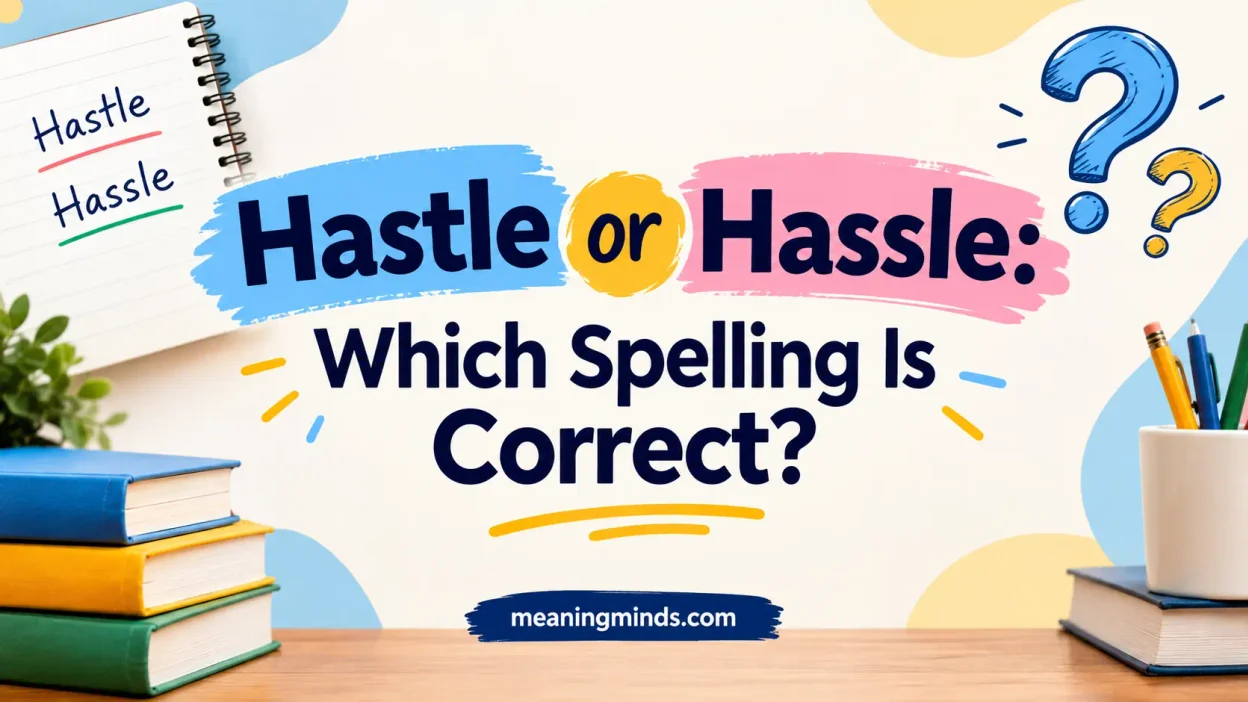
Create a clean 800×450 educational spelling graphic showing “HASSLE ✓” and “HASTLE ✗” in large centered typography, with a relatable busy-life scene featuring paperwork, a phone, and a person dealing with everyday problems, modern American English learning style, balanced composition, sharp readable typography, no empty areas, no unnecessary text.
Image Alt Text
Educational graphic comparing the correct spelling hassle with the incorrect spelling hastle.
Hastle or Hassle: Which Is Correct?
If you are unsure whether to write hastle or hassle, the correct spelling is hassle.
Hassle is a common English word that can be used as both a noun and a verb. As a noun, it refers to an annoying or difficult situation, especially one that causes extra trouble or effort. As a verb, it means to annoy, bother, or make someone deal with unnecessary difficulty. Cambridge Dictionary: hassle
Hastle is a common misspelling of hassle. If you mean “trouble,” “difficulty,” or “to bother someone,” use hassle with a double s.
Quick Answer
Hassle is the correct spelling. Hastle is incorrect in standard English when you mean a problem, inconvenience, or annoying situation. For example, write “I don’t want the hassle of returning it,” not “I don’t want the hastle of returning it.”
Hastle or Hassle: Which Spelling Is Correct?
The correct spelling is:
Hassle ✓
The incorrect spelling is:
Hastle ✗
The main difference is the second s.
| Spelling | Correct? | Meaning |
|---|---|---|
| hassle | ✓ Yes | Trouble, inconvenience, or annoyance |
| hastle | ✗ No | Common misspelling of hassle |
Examples
Correct:
- I don’t want the hassle of changing flights.
- Getting a refund was a real hassle.
- Don’t hassle me while I’m working.
Incorrect:
- I don’t want the hastle of changing flights.
- Getting a refund was a real hastle.
- Don’t hastle me while I’m working.
The standard spelling always contains two s’s:
H-A-S-S-L-E
What Does Hassle Mean?
Hassle generally refers to something that causes trouble, inconvenience, annoyance, or extra effort.
For example, if returning a product requires filling out several forms, making multiple phone calls, and waiting for a refund, you might say:
“Returning the product was a hassle.”
The word is especially useful for everyday situations that are not necessarily serious but are frustrating or inconvenient. Cambridge defines hassle as a situation that is annoying because it involves problems or difficulties. Cambridge Dictionary: hassle definition
Examples
- Finding parking downtown can be a hassle.
- I don’t want the hassle of cooking tonight.
- Moving to a new apartment was a huge hassle.
- The paperwork is more trouble than it’s worth.
Hassle as a Noun
As a noun, hassle refers to a difficult, annoying, or inconvenient situation.
Examples:
- The airport security process was a hassle.
- Dealing with customer service can be a hassle.
- I want to avoid the hassle.
- It was a lot of hassle for such a small problem.
Common expressions include:
a hassle
a big hassle
a lot of hassle
the hassle of something
For example:
I don’t want the hassle of driving in heavy traffic.
Here, hassle means the inconvenience and frustration involved in driving.
Hassle as a Verb
Hassle can also be a verb.
As a verb, it means to repeatedly bother, annoy, or pressure someone.
Examples:
- Stop hassling me.
- The salesperson kept hassling us to buy something.
- My brother always hassles me about being late.
The verb can also describe repeatedly causing someone trouble or demanding something from them.
For example:
The reporters hassled the actor for an interview.
In this sentence, hassled means they repeatedly bothered or pressured the actor.
How Do You Pronounce Hassle?
In American English, hassle is pronounced approximately:
HAS-uhl
Its IPA pronunciation is /ˈhæsəl/. Cambridge Dictionary pronunciation
The first syllable is stressed:
HAS-sle
The pronunciation can make the spelling slightly confusing because the second s is not strongly pronounced as a separate sound. However, the standard spelling still requires two s’s.
Why Is Hassle Spelled With Two Ss?
The standard spelling is:
H-A-S-S-L-E
The double s is part of the established spelling of the word.
There is no standard spelling rule that allows you to remove one of the s’s and write hastle. The words may sound similar when spoken quickly, but their written forms are different.
A useful way to remember it is:
HAS + SLE = HASSLE
Focus on the SS in the middle:
haSSle
Is Hastle a Word?
Hastle is not the standard English spelling of hassle.
If you are talking about trouble, inconvenience, annoyance, or bothering someone, use hassle.
Correct:
“This paperwork is such a hassle.”
Incorrect:
“This paperwork is such a hastle.”
If you see hastle in ordinary English writing, it is most likely a spelling error for hassle.
Hassle vs. Trouble
Hassle and trouble can overlap, but they are not always interchangeable.
Trouble is broader. It can describe a serious problem, difficulty, or situation that causes concern.
Hassle usually emphasizes annoyance, inconvenience, or unnecessary effort.
Compare:
“My car broke down, and I’m in trouble.”
This suggests a significant problem.
“Finding a parking space was a hassle.”
This suggests an annoying inconvenience.
A hassle does not necessarily represent a serious problem. It is often something frustrating that takes more time or effort than it should.
Hassle vs. Problem
A problem is something that needs to be solved or dealt with.
A hassle is often a problem viewed from the perspective of inconvenience or annoyance.
For example:
“The website has a payment problem.”
This identifies a specific issue.
“Paying through the website is a hassle.”
This emphasizes how inconvenient the process is.
You can have a problem without calling it a hassle, and something can be a hassle without being a major problem.
Is Hassle Formal or Informal?
Hassle is generally informal to neutral.
It is very common in everyday American English and works well in conversations, emails, reviews, and many forms of general writing.
For highly formal writing, alternatives such as inconvenience, difficulty, or complication may sometimes be more appropriate.
Compare:
Everyday:
“Getting a refund was a hassle.”
More formal:
“Obtaining a refund was an inconvenience.”
The choice depends on the tone you want.
Common Expressions With Hassle
Several common expressions use hassle naturally.
A hassle
“Parking here is a hassle.”
A big hassle
“Moving all this furniture is going to be a big hassle.”
The hassle of
“I don’t want the hassle of dealing with paperwork.”
Hassle-free
“The company promises a hassle-free return process.”
Hassle-free means without trouble, difficulty, or inconvenience.
For example:
“The online checkout was quick and hassle-free.”
Common Mistakes With Hassle
Mistake 1: Writing Hastle
Incorrect:
“Buying a new car can be a hastle.”
Correct:
“Buying a new car can be a hassle.”
Remember the double s.
Mistake 2: Removing an S in Hassled
The past tense is:
hassled ✓
Not:
hastled ✗
For example:
Correct:
“The customer said the salesperson hassled him.”
The double s remains when the verb changes form.
Mistake 3: Confusing Hassle With Hassel
Another spelling sometimes seen is hassel.
For the meaning of trouble or annoyance, the standard spelling is:
hassle ✓
Not:
hassel ✗
The ending is -le, not -el.
Hassle, Hassled, Hassling, and Hassles
Here are some common forms of the word:
| Form | Example |
|---|---|
| hassle | This is a hassle. |
| hassles | He hassles me about my work. |
| hassled | They hassled us at the door. |
| hassling | Stop hassling me. |
Notice that the double s remains in each form.
The spelling is:
hassle → hassles → hassled → hassling
Examples of Hassle in Sentences
- Finding a parking spot downtown is a hassle.
- I don’t want the hassle of returning the shoes.
- The paperwork turned into a major hassle.
- Traveling with too much luggage can be a hassle.
- She hates dealing with the hassle of long lines.
- Don’t hassle me while I’m trying to work.
- The salesman kept hassling us to buy the product.
- The new system makes the process hassle-free.
- It was a hassle, but we eventually solved the problem.
- I would rather pay a little more and avoid the hassle.
A Simple Trick to Remember the Spelling
Think of hassle as having two S’s in the middle:
HA + SS + LE
So:
HASSLE ✓
HASTLE ✗
You can also remember the phrase:
“Double S, less stress.”
When you mean an annoying problem or inconvenience, remember the double s in hassle.
Frequently Asked Questions
Is it hastle or hassle?
Hassle is the correct spelling. Hastle is a misspelling when you mean trouble, inconvenience, or annoyance.
What does hassle mean?
As a noun, hassle means an annoying or difficult situation that causes trouble or extra effort. As a verb, it means to bother, annoy, or pressure someone. Cambridge Dictionary: hassle
Is hassle a noun or a verb?
Hassle can be both a noun and a verb. You can say “The process is a hassle” or “Stop hassling me.”
How do you pronounce hassle?
In American English, hassle is pronounced approximately HAS-uhl, with the IPA /ˈhæsəl/. Cambridge Dictionary pronunciation
Is hastle a correct English word?
Not as the standard spelling of hassle. When you mean trouble, inconvenience, or annoyance, use hassle.
What is the past tense of hassle?
The past tense is hassled.
Example:
“The customer was hassled by the salesperson.”
Is hassle a formal word?
Hassle is common and natural in everyday American English, but it is somewhat informal. In highly formal writing, inconvenience, difficulty, or complication may sometimes be a better choice.
Conclusion
When choosing between hastle or hassle, the correct spelling is hassle.
Use hassle when you mean an annoying problem, inconvenience, or situation that requires extra effort. It can also be used as a verb meaning to bother, annoy, or pressure someone.
Remember the spelling:
H-A-S-S-L-E
Hassle ✓
Hastle ✗
If you are writing in standard American English, always use hassle for this meaning.