
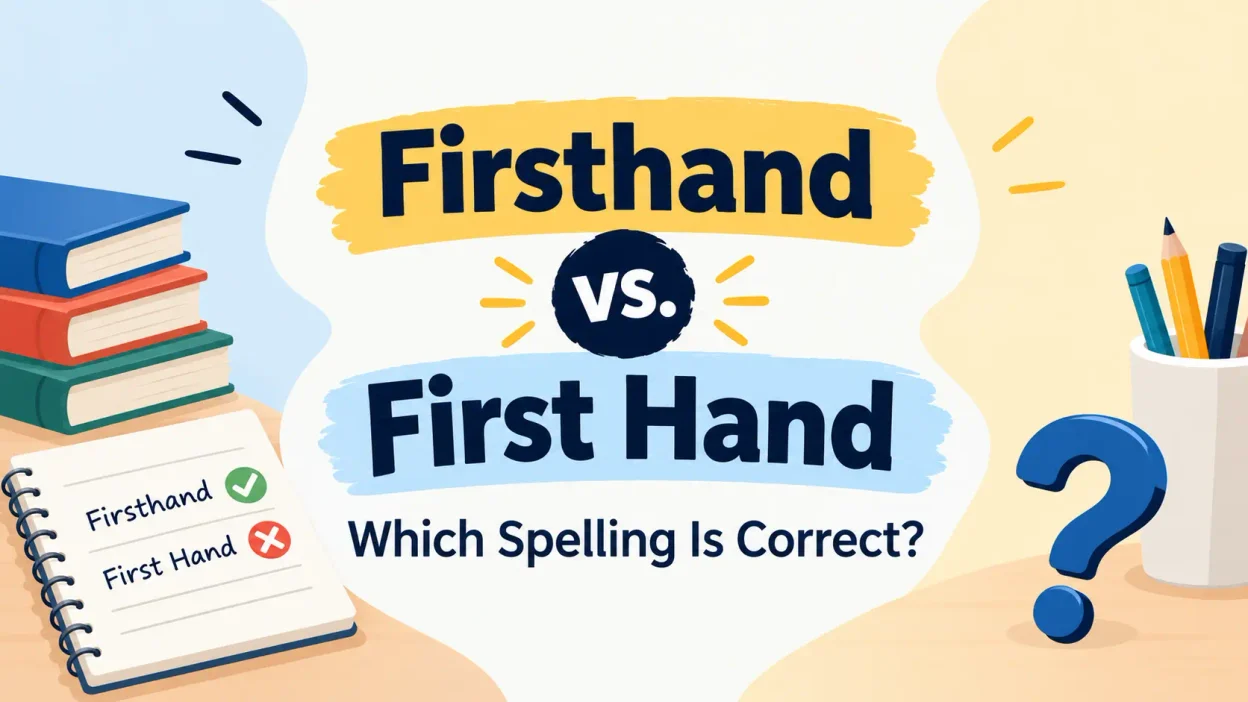
Featured Image Prompt: Create an 800×450 HD featured image for an American English grammar website. Display the title “FIRSTHAND vs. FIRST HAND” in large, centered, perfectly spelled typography. Highlight “FIRSTHAND” as the preferred American English spelling. Use a clean editorial design with a subtle notebook, a person observing an event, and a small magnifying glass to suggest direct experience and knowledge. Use a professional color palette, high contrast, balanced spacing, and a premium educational style. Keep all text fully visible, with no cropping, extra words, or watermark.
Image Alt Text: Firsthand vs. first hand spelling comparison showing the preferred one-word spelling in American English.
Quick Answer: Firsthand vs. First Hand
Firsthand is the preferred spelling in modern American English when describing knowledge or experience gained directly. It works as both an adjective and an adverb. The hyphenated form first-hand is also accepted, especially in British English and some editorial styles. The two-word form first hand appears in certain expressions, such as “at first hand,” but firsthand is usually the safest choice for American English writing.
- Firsthand: The preferred American English spelling.
- First-hand: An accepted alternative, particularly in British English.
- First hand: Used in specific expressions, including “at first hand.”
- Best choice for most U.S. writers: Use firsthand consistently.
What Does Firsthand Mean?
The word firsthand means that you experienced, observed, or learned something directly rather than relying on information passed along by someone else.
For example, if you visit a factory and watch how its products are made, you gain firsthand knowledge of the process. If someone tells you about the factory, your knowledge comes from another person’s account.
Firsthand can function as an adjective or an adverb.
Firsthand as an Adjective
An adjective describes a noun. Use firsthand before a noun when explaining that information, knowledge, or experience comes from direct observation or personal involvement.
Examples:
- She has firsthand experience in customer service.
- The reporter collected firsthand accounts from witnesses.
- We need firsthand information about the problem.
- His firsthand knowledge helped the research team.
- The students learned about farming through firsthand experience.
- The manager shared her firsthand observations of the workplace.
In these examples, firsthand describes experience, accounts, information, knowledge, or observations.
Firsthand as an Adverb
An adverb describes an action or explains how something happens. Use firsthand when someone experiences, observes, or learns something directly.
Examples:
- I witnessed the event firsthand.
- The students saw the historical site firsthand.
- She learned firsthand how difficult the job could be.
- We experienced the benefits of the new system firsthand.
- The journalist investigated the situation firsthand.
- He discovered firsthand what it takes to run a business.
In each sentence, firsthand explains that the experience happened directly.
What Does First Hand Mean?
The two-word form first hand is less common in general American English writing when referring to direct knowledge or experience. However, it appears in established expressions, particularly “at first hand.”
For example:
- She learned about the project at first hand.
- The researchers wanted to observe the process at first hand.
These sentences use an expression meaning directly or through personal experience. The wording is grammatical, although many American writers would use “firsthand” in a more direct construction.
Compare these examples:
- Preferred in American English: I saw the damage firsthand.
- Also possible: I saw the damage at first hand.
The first sentence is shorter and more natural for most contemporary American writing.
It is important not to assume that every occurrence of first hand is incorrect. The appropriate form depends on the expression and the style guide being followed.
Firsthand vs. First Hand: Comparison Table
| Feature | Firsthand | First hand |
|---|---|---|
| Spelling | One word | Two words |
| Common use | Direct experience or knowledge | Certain expressions |
| American English | Preferred general form | Less common |
| Adjective use | Firsthand experience | Usually prefer firsthand experience |
| Adverb use | Experienced it firsthand | Often used in “at first hand” |
| Meaning | Directly experienced or obtained | Can convey the same idea in a set expression |
| Best choice for most U.S. writing | Yes | Use when the expression calls for it |
Note: The hyphenated form first-hand is also accepted. Dictionaries differ in how they present spelling variants, so follow the style guide used by your publication.
Is Firsthand One Word or Two?
In modern American English, firsthand is generally written as one word. Major dictionaries, including Cambridge Dictionary and Oxford Learner’s Dictionaries, list firsthand as an adjective and adverb.
Examples of the standard one-word form include:
- Firsthand experience
- Firsthand knowledge
- Firsthand information
- Firsthand observation
- Firsthand account
- Firsthand research
These phrases are common in academic writing, journalism, business communication, and everyday conversation.
For example:
Preferred: The researcher gathered firsthand evidence from interviews.
Less typical in American English: The researcher gathered first hand evidence from interviews.
When you are unsure, write firsthand as one word unless you are using an established expression or following a style guide that specifies another form.
Is First-Hand Correct?
Yes. First-hand is an accepted spelling variant of firsthand. Both forms communicate the idea of direct experience or information obtained from an original source.
For example:
- She has first-hand knowledge of the issue.
- The witness provided a first-hand account.
- We received first-hand information from the team.
The hyphenated spelling is particularly familiar in British English and remains acceptable in many publications. American English commonly uses the closed compound firsthand.
The key is consistency. If your website or publication uses firsthand throughout its articles, avoid switching between firsthand and first-hand without a reason.
Firsthand vs. Secondhand
Understanding firsthand becomes easier when you compare it with secondhand.
Firsthand means you experience or obtain information directly. Secondhand means you receive information or an item indirectly, often through another person or a previous owner.
| Word | Meaning | Example |
|---|---|---|
| Firsthand | Directly experienced or obtained | I heard the announcement firsthand. |
| Secondhand | Learned indirectly or obtained from another person | I heard about the announcement secondhand. |
| Firsthand experience | Personal involvement or direct observation | She has firsthand experience in teaching. |
| Secondhand information | Information received through another source | The details were based on secondhand information. |
| Firsthand account | A report from someone directly involved or present | The witness gave a firsthand account of the accident. |
| Secondhand account | A report repeated by someone who may not have witnessed the event | His description was a secondhand account. |
The distinction matters because firsthand information may provide direct evidence, while secondhand information depends on another source. However, firsthand information is not automatically accurate; people can misunderstand or misremember what they experience.
Common Mistakes with Firsthand and First Hand
Writers sometimes use the forms inconsistently or assume that the two-word version is always wrong. These examples explain how to avoid common errors.
Mistake 1: Writing First Hand Experience in American English
Less preferred: She has first hand experience with the software.
Recommended: She has firsthand experience with the software.
Use firsthand as one word before a noun in standard American English.
Mistake 2: Assuming First-Hand Is Incorrect
Acceptable: He gave a first-hand account of the event.
Also acceptable: He gave a firsthand account of the event.
Both spellings are recognized. The choice often depends on regional usage or editorial preference.
Mistake 3: Confusing Firsthand with Secondhand
Incorrect for the intended meaning: I witnessed the accident secondhand.
If you personally saw the accident, use firsthand.
Correct: I witnessed the accident firsthand.
If someone else told you about the accident, secondhand may be more appropriate.
Mistake 4: Using First Hand in Every Situation
The two-word form appears in established expressions, such as “at first hand,” but it is not the preferred general spelling before nouns in American English.
Less natural for most American readers: The report contains first hand information.
Preferred: The report contains firsthand information.
Mistake 5: Switching Spellings Without a Reason
Using firsthand in one paragraph, first-hand in the next, and first hand elsewhere can make an article look inconsistent.
Better approach: Select one form, usually firsthand for an American audience, and apply it throughout the article except when using a particular expression or quoting a source.
How to Remember the Correct Spelling
A simple rule can help you choose the right form.
Use Firsthand for Direct Experience
When you mean that someone personally saw, heard, learned, or experienced something, use firsthand in most American English sentences.
Examples:
- I learned firsthand how the system works.
- The manager has firsthand knowledge of the issue.
- We collected firsthand accounts from local residents.
Remember the Expression “At First Hand”
The phrase “at first hand” is an established expression meaning directly or through personal experience.
Example:
- The students observed the process at first hand.
In everyday American English, you can often rewrite the sentence using firsthand:
- The students observed the process firsthand.
This simple substitution can make your writing more concise.
Firsthand vs. First Hand in Academic and Professional Writing
For essays, reports, website articles, and professional documents intended for American readers, firsthand is generally the most practical choice.
In academic writing, the term often describes evidence or knowledge obtained directly through observation, interviews, fieldwork, or personal involvement.
Examples:
- The researcher collected firsthand data through interviews.
- The report includes firsthand observations from field researchers.
- Employees provided firsthand feedback about the new policy.
In journalism, firsthand accounts may come from witnesses or people directly involved in an event. In business, firsthand experience can help explain how a process works in practice.
However, writers should distinguish between personal observation and independently verified evidence. Firsthand describes how information was obtained; it does not guarantee that the information is complete or correct.
Frequently Asked Questions
1. Is firsthand or first hand correct?
Firsthand is the preferred one-word spelling in modern American English. First hand also appears in expressions such as “at first hand.” The hyphenated spelling first-hand is accepted as well.
2. Is firsthand one word?
Yes. Firsthand is normally written as one word in American English when it means directly experienced or obtained. For example, “She has firsthand knowledge of the issue.”
3. Is first-hand grammatically correct?
Yes. First-hand is an accepted spelling variant. It is particularly common in British English and is also used by some American publications.
4. What does firsthand experience mean?
Firsthand experience means knowledge gained through personal involvement or direct observation rather than simply hearing about something from another person.
5. Should I use firsthand or first-hand in American English?
Use firsthand for most American English writing. First-hand is also accepted, but choosing one form consistently helps maintain a clear editorial style.
6. What is the difference between firsthand and secondhand?
Firsthand describes direct experience or information obtained from an original source. Secondhand describes information received indirectly or an item previously owned by someone else.
7. Is firsthand an adjective or an adverb?
It can be both. In “firsthand knowledge,” it is an adjective. In “I saw the event firsthand,” it is an adverb.
8. Is “at first hand” correct?
Yes. “At first hand” is an established expression meaning directly or through personal experience. However, “firsthand” is usually more concise in American English.
Practice Quiz: Firsthand vs. First Hand
Choose the best answer for each sentence.
1. I learned ______ how challenging the job can be.
- A. firsthand
- B. first hand
2. She has ______ knowledge of the company’s operations.
- A. first hand
- B. firsthand
3. The journalist witnessed the event ______.
- A. firsthand
- B. first hand
4. The hyphenated spelling ______ is also accepted.
- A. first-hand
- B. firsthanded
5. Which spelling is generally preferred in modern American English?
- A. Firsthand
- B. First hand
Quiz Answers
- A. Firsthand — It functions as an adverb.
- B. Firsthand — It describes the noun knowledge.
- A. Firsthand — It explains how the journalist witnessed the event.
- A. First-hand — This is an accepted spelling variant.
- A. Firsthand — The one-word form is the usual choice in American English.
Conclusion
When deciding between firsthand and first hand, choose firsthand for most modern American English writing. It describes knowledge, information, or experience gained directly and works as both an adjective and an adverb.
The hyphenated spelling first-hand is also correct, while first hand appears in established expressions such as “at first hand.” The most important rule is to use the form that fits the sentence and remain consistent throughout your writing.