
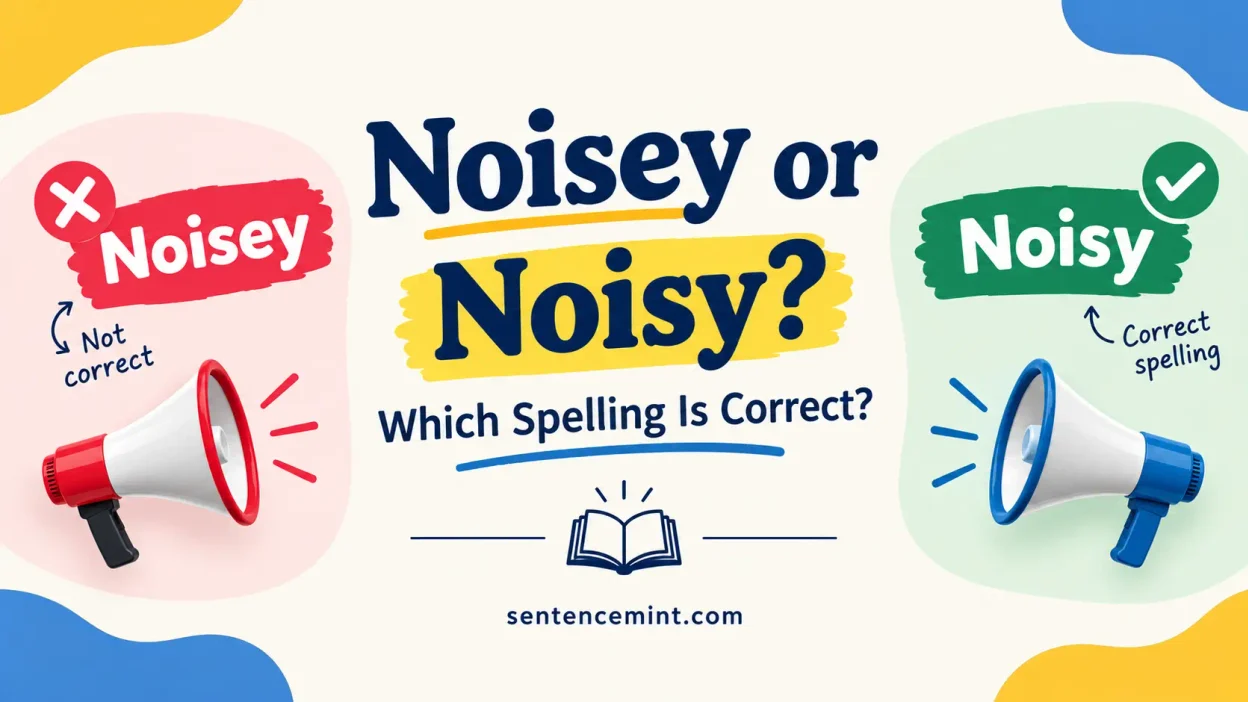
Featured Image Prompt
Create a premium 800 × 450 pixel English spelling comparison image. Display “NOISEY OR NOISY?” in large, centered typography, with “NOISY” clearly highlighted as the correct standard spelling. Include a lively classroom, a busy city street, and subtle sound-wave graphics to represent noise. Use a modern navy blue, white, and yellow palette, clean educational design, strong contrast, and generous spacing. Ensure all text is sharp, correctly spelled, and fully visible without cropping. No watermark.
Image Alt Text
Noisey or noisy spelling comparison showing noisy as the correct standard English spelling.
Noisey or Noisy: Which Spelling Is Correct?
If you are unsure whether to write noisey or noisy, the correct choice in standard American English is noisy. It is an adjective that describes something that makes a lot of sound or is full of noise. You might use it to describe a crowded classroom, a busy street, a loud machine, or a group of excited children.
The spelling noisey may look reasonable because it resembles the noun noise. However, it is not the standard spelling of this adjective in modern English. Learning the correct form and a few related spelling patterns will help you avoid this common mistake in schoolwork, emails, and professional writing.
Quick Answer
Noisy is the correct standard spelling, while noisey is generally a misspelling when you mean making or containing a lot of noise. The word comes from noise and ends in -y, not -ey. For example, write “The classroom is noisy,” not “The classroom is noisey.”
What Does Noisy Mean?
Noisy is an adjective that describes someone or something that produces a lot of sound. Depending on the context, it can suggest that the sound is loud, distracting, unpleasant, or simply noticeable.
Examples:
- The restaurant gets noisy during lunch.
- My neighbors are noisy on weekends.
- The old washing machine is unusually noisy.
- The children became noisy during the school break.
- We moved to a quieter street because the traffic was too noisy.
The word does not always mean that a sound is unpleasant. A lively party can be noisy because people are laughing, talking, and enjoying themselves. In contrast, a noisy construction site may be difficult to tolerate because of constant machinery.
Noisy in everyday English
People commonly use noisy to describe places, people, animals, and machines.
Examples:
- A noisy classroom
- A noisy neighborhood
- A noisy dog
- A noisy engine
- A noisy crowd
It can also describe unwanted sound in technical settings, such as a noisy recording or a noisy electronic signal.
Noisey vs. Noisy: What Is the Difference?
The main difference is standard spelling.
| Word | Status | Meaning or Use |
|---|---|---|
| Noisy | Standard spelling | Making or characterized by a lot of noise |
| Noisey | Generally nonstandard for this meaning | Usually an incorrect spelling of noisy |
| Noise | Standard noun | A sound, especially one that is unwanted or noticeable |
| Noisier | Standard comparative | Producing more noise |
| Noisiest | Standard superlative | Producing the most noise |
For ordinary modern writing, use noisy. The spelling noisey may appear in older material, informal writing, or proper names, but it is not the standard adjective spelling.
For example:
Incorrect: The office became noisey after lunch.
Correct: The office became noisy after lunch.
Both sentences are understandable, but the second uses the accepted spelling.
Why Is Noisy Spelled Without the E?
The word noisy is formed from the noun noise and the suffix -y. The established spelling drops the final e before adding y.
The spelling pattern is:
noise → noisy
The final e does not remain in the adjective. Therefore, noisey is not the conventional spelling.
Similar examples include:
| Base Word | Correct Adjective |
|---|---|
| Ice | Icy |
| Spice | Spicy |
| Shine | Shiny |
| Grease | Greasy |
| Haze | Hazy |
| Noise | Noisy |
These examples help illustrate the pattern, although English spelling has exceptions. For this particular word, remember the established form rather than relying only on a general rule.
How to Use Noisy Correctly in Sentences
Here are practical examples showing how noisy works in everyday American English.
Describing places
- The library was quiet, but the cafeteria was noisy.
- Our street becomes noisy during rush hour.
- The hotel room was too noisy for a good night’s sleep.
Describing people and animals
- The children were noisy after recess.
- Our neighbor has a noisy dog.
- The audience became noisy while waiting for the show.
Describing machines and technology
- My laptop fan becomes noisy when I run several programs.
- The old air conditioner is noisy at night.
- The recording has a noisy background that makes the speaker difficult to hear.
Describing comparisons
- The main road is noisier than our side street.
- This machine is less noisy than the older model.
- That was the noisiest classroom in the building.
These examples also show how the word changes when you compare different levels of noise.
Noisy, Noisier, and Noisiest: Correct Word Forms
The adjective noisy has standard comparative and superlative forms.
| Form | When to Use It | Example |
|---|---|---|
| Noisy | Describes something that makes a lot of noise | The bus is noisy. |
| Noisier | Compares two people or things | The bus is noisier than the car. |
| Noisiest | Identifies the most noisy item in a group | This is the noisiest bus on the route. |
| Noisily | Describes how an action is performed | The children talked noisily. |
| Noisiness | Refers to the quality or condition of being noisy | The noisiness of the room made it hard to concentrate. |
Notice that noisier and noisiest replace the final y with i before adding -er or -est.
Common mistakes include noiseyer and noiseyest. Use noisier and noisiest instead.
Is Noisy the Same as Loud?
Not exactly. The words overlap, but they can emphasize different things.
Loud usually focuses on the volume or intensity of a sound. Noisy often describes an environment or source that produces a lot of sound, particularly when that sound is distracting or unwanted.
Compare these examples:
- The music is loud. — The volume is high.
- The restaurant is noisy. — Many sounds make the environment busy or distracting.
- The alarm is loud and noisy. — The alarm has high volume and creates an intrusive sound.
In some situations, either word works. However, noisy is often a natural choice when describing a place filled with conversation, traffic, or several competing sounds.
Common Mistakes With Noisey and Noisy
Mistake 1: Adding an extra e
Incorrect: The classroom was very noisey.
Correct: The classroom was very noisy.
Why: The standard adjective is spelled noisy, without an e before the final y.
Mistake 2: Misspelling the comparative form
Incorrect: The new fan is noiseyer than the old one.
Correct: The new fan is noisier than the old one.
Why: The comparative form changes the final y to i before adding -er.
Mistake 3: Misspelling the superlative form
Incorrect: Friday was the noiseyest day of the week.
Correct: Friday was the noisiest day of the week.
Why: The standard superlative spelling is noisiest.
Mistake 4: Assuming noisy always means unpleasant
Incorrect assumption: A noisy gathering must be a bad gathering.
Better understanding: A gathering can be noisy because people are talking, laughing, or celebrating. The word describes the sound level or amount of noise; context determines whether it sounds negative.
Mistake 5: Assuming British English uses noisey
Incorrect assumption: Noisey is the British spelling, while noisy is American.
Correct understanding: Noisy is the standard spelling in both American and British English. There is no standard regional spelling difference here.
Frequently Asked Questions
Is noisey or noisy correct?
Noisy is the correct standard spelling when describing something that makes a lot of noise. Noisey is generally considered a misspelling in ordinary modern English.
Is noisey ever a real word?
The spelling noisey appears in some historical or specialized contexts, and it can also occur in proper names. However, it is not the standard spelling of the adjective meaning full of noise. Use noisy in ordinary writing.
Why do people spell noisy as noisey?
People may keep the final e from noise when adding the adjective ending. Although that spelling looks plausible, the established form is noisy.
Is noisy spelled differently in American and British English?
No. Both American and British English use noisy. Unlike words such as color and colour, this adjective has no standard American-British spelling difference.
What is the comparative form of noisy?
The comparative form is noisier. For example, “The cafeteria is noisier than the library.”
What is the superlative form of noisy?
The superlative form is noisiest. For example, “This is the noisiest street in our neighborhood.”
What is the difference between noise and noisy?
Noise is a noun referring to a sound or sounds. Noisy is an adjective describing something that produces or contains a lot of noise. For example, “The noise was distracting because the room was noisy.”
Conclusion
When choosing between noisey and noisy, use noisy. It is the standard spelling in American English and British English and describes something that makes or contains a lot of sound.
Remember the correct word forms: noisy, noisier, noisiest, noisily, and noisiness. With these spellings in mind, you can describe loud environments, busy crowds, and noisy machines clearly and correctly.