
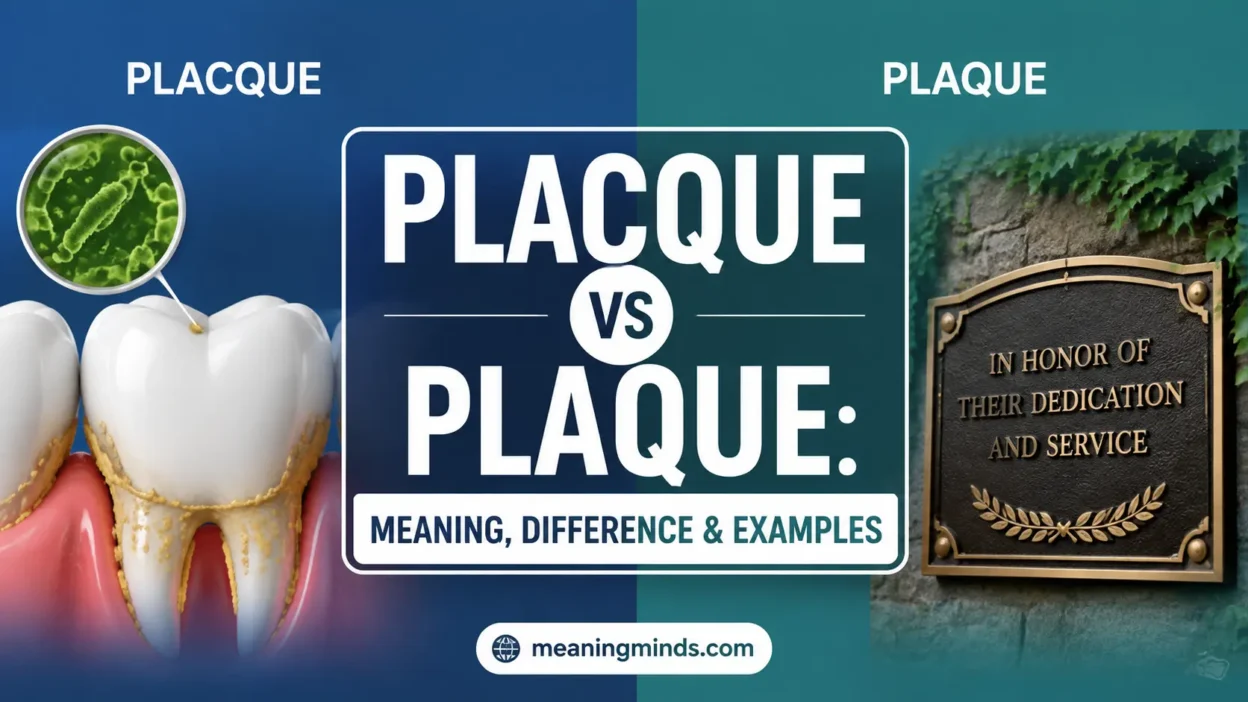
Featured Image Prompt
Create a professional educational comparison image for “Placque vs Plaque.” Show a dental plaque illustration, a commemorative wall plaque, and a red spelling correction mark over “placque.” Use clean medical and educational visuals, bold centered typography, realistic details, and a balanced 16:9 layout.
Image Alt Text
Comparison graphic showing plaque as dental buildup and an award sign, with placque shown as an incorrect spelling.
Placque vs Plaque: What’s the Difference?
Placque and plaque look almost identical, but they do not have the same status in modern English. Plaque is the correct and commonly used spelling. It can refer to a sticky buildup on teeth, a decorative or commemorative metal plate, or a layer of material deposited on a surface.
Placque is generally considered a misspelling of plaque and is not used in standard English.
The simple rule:
Plaque = correct spelling.
Placque = usually incorrect.
Quick Answer
Plaque is the standard English spelling for a dental buildup, an engraved memorial or award plate, or a deposited layer of material. Placque is not a standard modern English word and is usually a spelling mistake. If you are writing about teeth, awards, signs, or scientific deposits, use plaque.
Placque vs Plaque at a Glance
| Word | Meaning | Usage | Example |
|---|---|---|---|
| Plaque | Dental buildup, decorative plate, or deposited layer | Correct and common | The dentist removed the plaque from his teeth. |
| Placque | Rare/nonstandard spelling | Usually incorrect | Avoid using this spelling in normal writing. |
What Does Plaque Mean?
Plaque is a noun with several meanings depending on context.
The word is commonly used in:
- dentistry
- awards and memorials
- medicine
- science
Plaque in Dentistry
In dental health, plaque is a sticky film of bacteria that forms on teeth.
It develops when bacteria in the mouth combine with:
- food particles
- saliva
- sugars
If plaque is not removed through brushing and cleaning, it can contribute to:
- tooth decay
- cavities
- gum disease
Examples:
- Brush your teeth daily to remove plaque.
- The dentist found plaque buildup near the gums.
- Regular cleaning helps prevent dental plaque.
Plaque vs Tartar
Plaque and tartar are related but different.
Plaque is soft and can usually be removed through regular brushing.
Tartar (also called calculus) is hardened plaque that requires professional cleaning.
Example:
The dentist removed tartar that had formed from untreated plaque.
Plaque as a Commemorative Plate
A plaque can also be a flat piece of metal, wood, stone, or another material with writing or decoration on it.
It is often used for:
- awards
- memorials
- historical markers
- recognition displays
Examples:
- The building has a plaque honoring its founder.
- She received a plaque for outstanding service.
- A bronze plaque marked the historic location.
Plaque in Science and Medicine
In scientific contexts, plaque can describe a layer or buildup of material.
Examples:
- Researchers studied plaque buildup in blood vessels.
- Scientists observed viral plaques in laboratory studies.
In medicine, arterial plaque refers to deposits that can form inside arteries.
What Does Placque Mean?
Placque is generally not considered a standard English spelling.
It may appear because people confuse the spelling of plaque and add an extra “c.”
The correct spelling is:
✅ plaque
Not:
❌ placque
Examples:
Correct:
The dentist removed plaque from my teeth.
Incorrect:
The dentist removed placque from my teeth.
Why Do People Confuse Placque and Plaque?
The confusion usually comes from pronunciation and spelling patterns.
The word plaque is pronounced:
PLAK
The final “que” spelling can make people think an additional “c” belongs in the word.
However, English spelling does not always match pronunciation perfectly.
Similar examples:
- antique
- unique
- plaque
The “que” ending already creates the correct sound.
Plaque Pronunciation
Plaque is pronounced:
PLAK
It rhymes with:
- back
- black
- track
Example:
The dentist explained how plaque affects teeth.
Because placque is not a standard word, it does not have a separate accepted pronunciation.
Common Uses of Plaque
Dental Plaque
Example:
Removing plaque helps maintain healthy teeth.
Meaning:
A bacterial film on teeth.
Award Plaque
Example:
The employee received a plaque for 20 years of service.
Meaning:
An engraved recognition plate.
Memorial Plaque
Example:
A plaque was placed on the building to honor the inventor.
Meaning:
A marker with information or remembrance.
Arterial Plaque
Example:
Doctors monitored plaque buildup in the arteries.
Meaning:
Deposits inside blood vessels.
Plaque vs Plate
These words can sometimes be confused.
Plaque
Usually refers to a decorative or informational flat object with writing.
Example:
The museum displayed a historical plaque.
Plate
Usually refers to a broader category of flat objects.
Examples:
- dinner plate
- metal plate
- license plate
A plaque is a type of plate, but not every plate is a plaque.
Plaque vs Plague
Another common confusion is between plaque and plague.
Plaque
Means:
- dental buildup
- commemorative plate
- deposited material
Example:
The dentist removed plaque.
Plague
Means:
- a serious infectious disease
- a widespread harmful problem
Example:
The city faced a plague outbreak.
The pronunciation differs:
- plaque → PLACK
- plague → PLAYG
Common Mistakes With Placque and Plaque
Mistake 1: Adding an Extra “C”
Incorrect:
The school gave him a placque.
Correct:
The school gave him a plaque.
The correct spelling has one “c.”
Mistake 2: Using Plaque When You Mean Plague
Incorrect:
The town suffered from a plaque.
Correct:
The town suffered from a plague.
A disease outbreak is a plague, not a plaque.
Mistake 3: Confusing Dental Plaque With Tartar
Incorrect:
Plaque is always hard and permanent.
Better:
Plaque is a soft bacterial film that can harden into tartar.
Easy Way to Remember Placque vs Plaque
Remember:
Plaque has “que” at the end.
Think:
- plaque on teeth
- plaque on a wall
- plaque in arteries
There is no extra “c.”
A quick spelling trick:
One C = plaque.
Example Sentences With Plaque
- The dentist removed the plaque from her teeth.
- Brushing regularly prevents plaque buildup.
- The athlete received a plaque for winning the championship.
- A bronze plaque marked the historic building.
- Doctors examined plaque buildup in the arteries.
- The museum displayed a memorial plaque.
- Dental plaque can lead to cavities.
- The organization presented him with a recognition plaque.
Example Sentences With Placque
Because placque is not a standard English word, it should generally not be used.
Incorrect:
The winner received a placque.
Correct:
The winner received a plaque.
Frequently Asked Questions
Is placque a correct spelling?
No. Placque is generally considered a misspelling. The correct spelling is plaque.
What is plaque on teeth?
Dental plaque is a sticky layer of bacteria that forms on teeth. If not removed, it can contribute to cavities and gum problems.
What does plaque mean besides dental buildup?
Plaque can also mean an engraved plate used for awards, memorials, or signs. It can also describe certain types of deposits in science and medicine.
Are plaque and plague the same?
No. Plaque refers to a buildup, plate, or deposit. Plague refers to a disease or widespread harmful event.
How do you pronounce plaque?
Plaque is pronounced “plak,” rhyming with words like “black” and “track.”
Why do people spell plaque as placque?
People often add an extra “c” because the pronunciation suggests a different spelling pattern. However, the standard spelling is simply plaque.
Conclusion
The difference between placque vs plaque is simple: plaque is the correct English spelling, while placque is usually an error.


