Featured Image Prompt
Create a professional 800 × 450 educational English spelling comparison graphic. Show the words “SCARRY OR SCARY?” in large, centered, readable typography. Feature a spooky, shadowy house and a frightened expression to illustrate the meaning of scary, with a small visual reference to a scarred surface for the rare word scarry. Use a clean navy blue, white, and muted orange palette, balanced composition, high contrast, generous margins, and no cropped text. Make the image suitable for an American English grammar website.
Image Alt Text
Educational spelling comparison of scarry and scary, illustrating fear and the rare meaning related to scars.
Scarry or Scary: Which Word Is Correct?
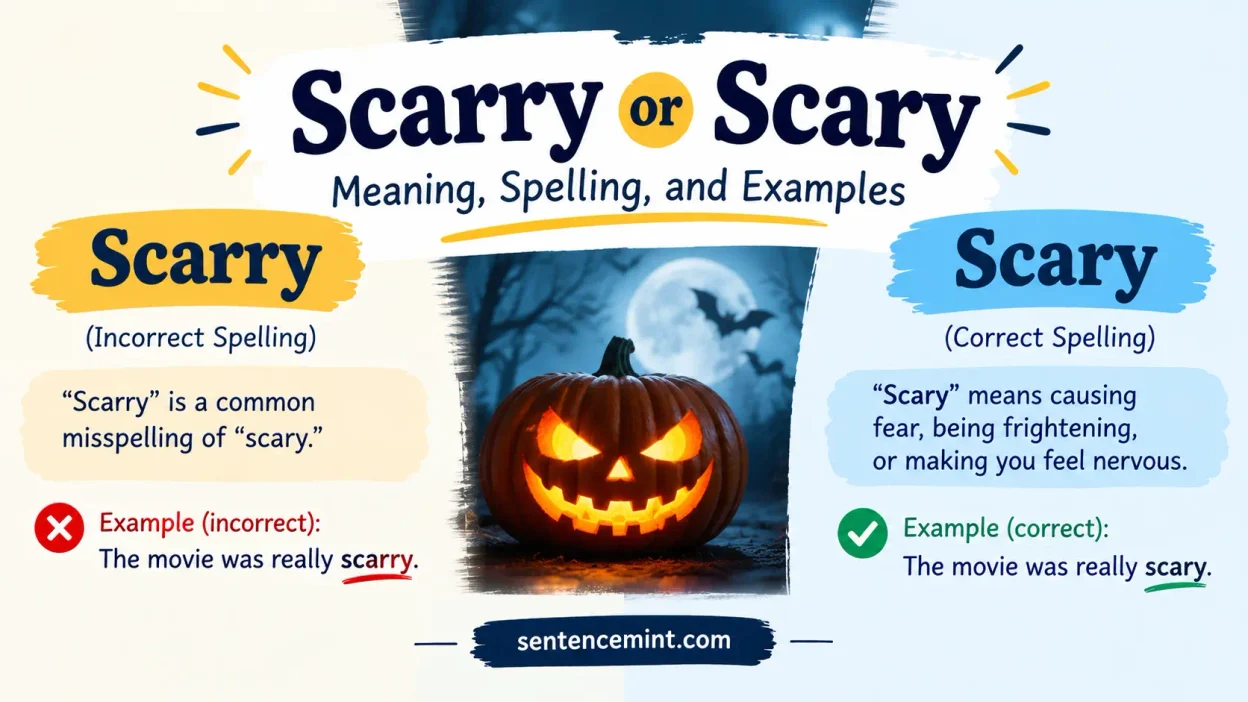
If you are deciding between scarry and scary, the right choice depends on what you want to say. When describing something frightening, such as a horror movie, a strange noise, or a dangerous situation, scary is the standard spelling in American English.
However, there is an important detail: scarry is not always a misspelling. It is a rare English adjective that can describe something marked with scars or a place full of steep, rocky terrain. These meanings are uncommon in everyday conversation, so writers often need scary instead.
Understanding this distinction will help you avoid spelling mistakes and recognize the less common word when you encounter it.
Quick Answer
Scary is the standard spelling when you mean frightening or causing fear. For example, “That movie was scary.” Scarry is a rare but legitimate word with meanings related to scars or steep, rocky places. Use scary for ordinary descriptions of fear, and use scarry only when its specialized meaning fits the context.
What Does Scary Mean?
Scary is an adjective that describes something that causes fear, alarm, nervousness, or uneasiness. It is common in American English and works in casual conversation, storytelling, reviews, and many other types of writing.
Examples:
- The abandoned house looked scary at night.
- That was the scariest movie I have ever watched.
- Driving through the storm was a scary experience.
- Starting at a new school can feel scary.
- The sudden noise gave me a scary moment.
The word does not always describe ghosts, monsters, or horror stories. It can also describe a situation that feels dangerous, uncertain, or intimidating.
For example, a person might say, “The financial situation looks scary.” Here, scary describes worry or concern rather than a literal threat.
What Does Scarry Mean?
Scarry is a rare adjective with meanings that differ from the usual meaning of scary. Established dictionaries record two main senses.
1. Marked with scars
In this sense, scarry describes something bearing scars or marks left by wounds.
Example:
“The animal had a scarry hide marked by old wounds.”
This is a specialized and uncommon use. In everyday American English, most writers would choose a clearer phrase such as covered with scars or scarred.
2. Steep and rocky
Scarry can also describe terrain filled with steep, rocky, or precipitous places.
Example:
“The hikers crossed a scarry stretch of mountainous terrain.”
This meaning is rare and may sound unfamiliar to many readers. In ordinary writing, steep and rocky or rugged would usually communicate the idea more clearly.
The key point is that scarry is a real word, but it does not normally mean frightening. That meaning belongs to scary.
Scarry vs. Scary: Key Differences
| Feature | Scary | Scarry |
|---|---|---|
| Part of speech | Adjective | Adjective |
| Main meaning | Frightening or causing fear | Marked with scars or full of steep, rocky places |
| Frequency in everyday English | Common | Rare |
| Typical context | Movies, stories, situations, feelings | Specialized descriptions of scars or terrain |
| Best choice for a frightening movie | Yes | No |
| Suitable for ordinary American English | Yes | Only when its rare meaning is intended |
The difference is not simply one extra letter. The two spellings can carry different meanings, so replacing one with the other may change the message.
Examples of Scary in Sentences
Here are practical examples showing how scary works in different contexts.
Scary in everyday conversation
- “That dog looks scary, but it is actually friendly.”
- “I heard a scary noise coming from the basement.”
- “The roller coaster looked scary from the ground.”
In each sentence, scary describes something that creates fear or nervousness.
Scary in movies and stories
- “We watched a scary movie on Halloween.”
- “The author wrote a scary story about a haunted hotel.”
- “The ending was even scarier than I expected.”
The word is especially natural when describing horror, suspense, and frightening experiences.
Scary in serious situations
- “The sudden drop in sales was scary for the business owner.”
- “It was scary to hear that someone had broken into the neighborhood.”
- “The doctor explained the risks, and the situation sounded scary.”
These examples show that scary can describe emotional reactions to uncertainty or possible danger, not just fictional horror.
Examples of Scarry in Sentences
Because scarry is uncommon, examples should make its intended meaning clear.
- “The old animal had a scarry body marked by numerous healed wounds.”
- “The explorers moved carefully across the scarry, rocky landscape.”
- “The report described a scarry region with steep rock formations.”
In modern writing, alternatives such as scarred, rugged, or rocky will often sound more natural.
Also, Scarry can be a proper name. Richard Scarry was an American children’s book author and illustrator. When referring to him or another person with that surname, retain the spelling of the name.
Why Do People Confuse Scarry and Scary?
Several factors make the two spellings easy to mix up.
The words look almost identical
The only spelling difference is the additional letter r in scarry. When people type quickly, it is easy to add an extra letter without noticing.
Other English words use double r
Words such as carry, marry, and sorry contain two r’s. Someone familiar with these words might mistakenly assume that scary should follow the same pattern.
However, the standard adjective is spelled scary, with one r in the middle.
Pronunciation does not always help
In many American English accents, scary and scarry are pronounced alike or very similarly. Because the sound may not reveal the spelling, it is useful to remember the meaning and conventional spelling of each word.
How to Remember the Correct Spelling
A simple way to remember scary is to connect it with the verb scare.
- Scare: to frighten someone.
- Scary: causing fear.
- Scared: feeling fear.
Examples:
- The loud noise may scare the child.
- The loud noise is scary.
- The child feels scared.
Notice the difference between scary and scared. Something is scary when it causes fear; a person is scared when they experience that fear.
You can use this distinction to choose the correct word in most everyday situations.
Scary, Scared, and Scarred: What Is the Difference?
These three words look similar, but their meanings are different.
| Word | Meaning | Example |
|---|---|---|
| Scary | Causing fear | The dark hallway looked scary. |
| Scared | Feeling fear | I was scared by the noise. |
| Scarred | Marked by a scar or emotionally affected by a painful experience | His hand was scarred after the injury. |
Scary describes the source of fear, while scared describes the person experiencing it. Scarred usually refers to a lasting physical mark or, figuratively, an emotional effect.
Do not confuse scarred with scarry. Although the words are related in meaning, scarred is the more familiar and generally preferred word for something bearing scars.
Common Mistakes to Avoid
Mistake 1: Writing scarry when you mean frightening
Incorrect: The haunted house was scarry.
Correct: The haunted house was scary.
Why: Scary is the conventional spelling for something that causes fear.
Mistake 2: Assuming scarry is never a real word
Incorrect assumption: The spelling scarry has no meaning in English.
Better understanding: Scarry is a rare dictionary word with specialized meanings related to scars and rocky terrain.
Why: A word can be legitimate without being common or suitable for everyday use.
Mistake 3: Confusing scary with scared
Incorrect: I was very scary during the storm.
Better: I was very scared during the storm.
Why: Scared describes how a person feels. Scary describes something that causes fear.
Mistake 4: Using scarry when scarred is clearer
Less natural: His face was scarry after the accident.
Clearer: His face was scarred after the accident.
Why: Scarred is the more familiar adjective for something marked by scars.
Frequently Asked Questions
Is scarry a real word?
Yes. Scarry is a rare English adjective recorded in dictionaries. It can describe something marked with scars or terrain containing steep, rocky places. It is not the standard spelling when you mean frightening.
Which is correct: scarry or scary?
Use scary when describing something frightening, alarming, or likely to cause fear. Scarry is correct only when you intend one of its uncommon dictionary meanings or are using it as a proper name.
What does scary mean in simple English?
Scary means frightening or making someone feel afraid. For example, a loud noise in a dark room might be scary because it makes someone feel nervous or frightened.
What is the difference between scary and scared?
Scary describes something that causes fear, while scared describes someone who feels fear. For example, “The movie was scary, and I was scared.”
Is scarry the same as scarred?
No. Scarry is a rare adjective meaning marked with scars, while scarred is the more common word for something bearing scars. In everyday writing, scarred is usually the clearer choice.
Is scary used in American and British English?
Yes. Scary is used in both varieties of English. Cambridge also records scarey as a British variant, but scary remains the standard spelling to choose in ordinary American English.
Conclusion
When choosing between scarry and scary, focus on the meaning you intend. Scary is the standard everyday adjective for something frightening, while scarry is a rare word associated with scars or steep, rocky terrain.
For school assignments, professional writing, everyday conversations, and descriptions of horror movies or frightening situations, choose scary. Use scarry only when its uncommon meaning is specifically intended.
Remember: scary means frightening; scarry has specialized meanings related to scars or rocky places.