
Featured Image Prompt
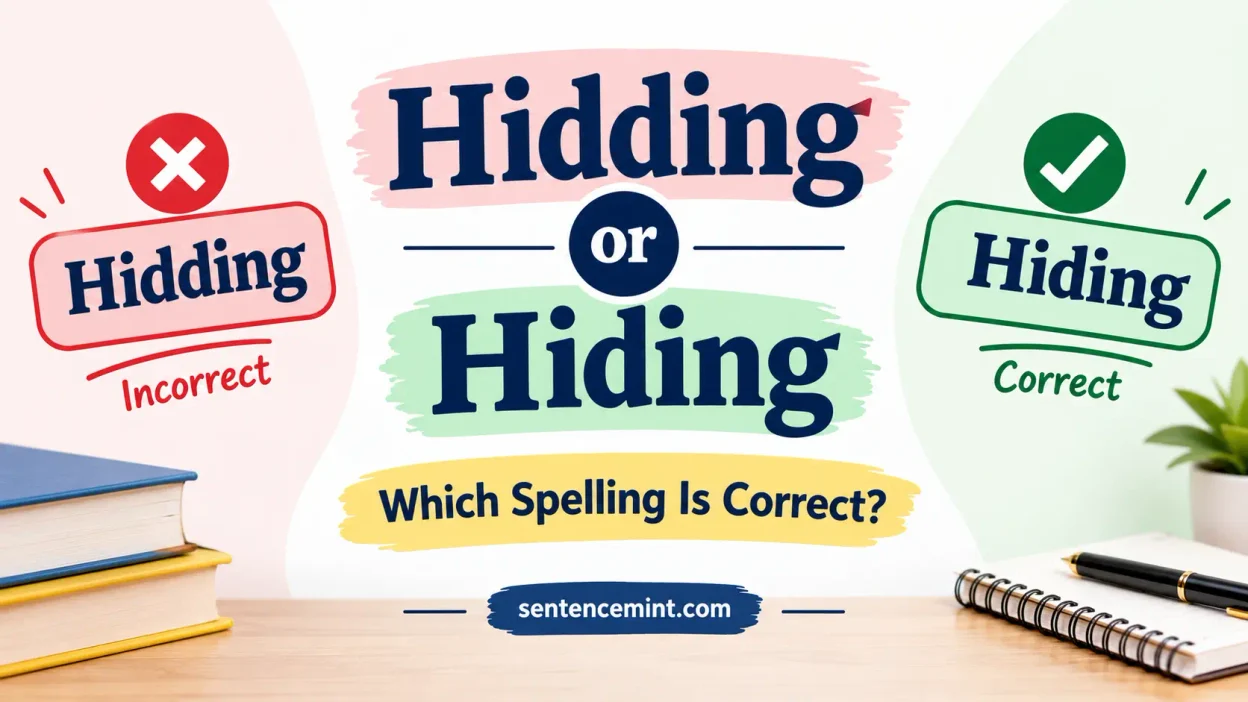
Create a professional 800 × 450 pixel English spelling educational graphic comparing “HIDDING” and “HIDING.” Highlight “HIDING” as the correct standard spelling in American English. Show a child hiding behind a tree or a person concealing a small object, with a subtle spelling correction symbol. Use a clean navy blue, white, and light green color palette, readable typography, balanced spacing, and a centered headline. Keep all text within the image boundaries, avoid cropping, and create a polished design suitable for an English grammar website.
Image Alt Text
English spelling comparison showing hiding as the correct spelling and hidding as a common misspelling.
Hidding or Hiding: Which Spelling Is Correct?
If you are unsure whether to write hidding or hiding, the correct choice in standard American English is hiding, with one d. It is the present participle of the verb hide, which means to put something where it cannot easily be seen or to keep something out of sight.
The spelling hidding is a common mistake because many English verbs double their final consonant when adding -ing. However, hide follows a different spelling rule. Its final e is dropped before -ing is added, giving you hiding, not hidding.
Understanding this rule can also help you spell other words correctly.
Quick Answer
Hiding is the correct spelling; hidding is incorrect in standard English. The verb hide becomes hiding when you add -ing: remove the final e and add -ing. For example, “The cat is hiding under the bed.” Always use hiding in schoolwork, professional writing, and everyday communication.
What Does Hiding Mean?
Hiding is the present participle of hide. It can describe the action of concealing a person or object, staying out of sight, or keeping information from others.
The word can appear in continuous verb forms, as a gerund, or as part of a phrase.
Examples:
- The children are hiding behind the sofa.
- She is hiding the birthday present in her closet.
- He was hiding from the rain under a shelter.
- Hiding the truth can damage trust.
- The dog is hiding its favorite toy in the yard.
In each example, hiding describes an action or activity related to concealment.
Hiding as an ongoing action
When you use hiding with a form of be, it often shows that an action is happening or was happening at a particular time.
Examples:
- I am hiding behind the door.
- They were hiding when the lights went out.
- The rabbit is hiding in the bushes.
Hiding as a noun-like activity
The -ing form can also function as a gerund, acting like a noun in a sentence.
Examples:
- Hiding is part of the game.
- Hiding from your problems will not solve them.
- The children enjoy hiding during hide-and-seek.
Why Is Hiding Correct Instead of Hidding?
The difference comes from the spelling rules used when adding -ing to English verbs.
The base verb is hide. When a verb ends in a silent e, that e is usually dropped before adding -ing.
The spelling changes as follows:
hide + ing → hiding
The final e disappears, and the remaining letters stay the same. You do not double the d.
By contrast, verbs such as sit and run double their final consonants when forming sitting and running. Those verbs follow a different spelling pattern.
The Spelling Rule for Verbs Ending in Silent E
Many verbs ending in a silent e drop that letter before taking the -ing ending.
| Base Verb | Correct -ing Form | Incorrect Form |
|---|---|---|
| Hide | Hiding | Hidding |
| Make | Making | Makeing |
| Write | Writing | Writeing |
| Take | Taking | Takeing |
| Drive | Driving | Driveing |
| Hope | Hoping | Hopeing |
| Dance | Dancing | Danceing |
| Smile | Smiling | Smileing |
The pattern is straightforward: remove the final silent e, then add -ing.
There are exceptions and special spelling patterns in English, but hide follows this regular rule.
When Do You Double the Final Consonant Before Adding -Ing?
English sometimes doubles a final consonant before adding -ing. This commonly happens with a one-syllable verb ending in a consonant-vowel-consonant pattern, provided the final consonant is eligible for doubling.
Examples include:
- Sit → sitting
- Run → running
- Stop → stopping
- Plan → planning
- Get → getting
The verb hide does not follow this pattern because it ends in a silent e. Therefore, its correct form is hiding, not hidding.
Compare these examples:
- Correct: The boy is hiding.
- Correct: The boy is sitting.
- Incorrect: The boy is hidding.
- Incorrect: The boy is siting, when the intended word is the present participle of sit.
Remember that spelling rules depend on the base verb. Do not apply the consonant-doubling rule to every word that ends with a consonant sound.
Hiding in Sentences: Practical Examples
Here are examples showing how to use hiding naturally in different situations.
Everyday situations
- My keys are hiding under a pile of papers.
- The puppy is hiding behind the curtains.
- I was hiding from the cold wind inside the house.
School and work
- The student was hiding his phone during class.
- The company was accused of hiding important information.
- She is hiding the documents in a secure folder.
Feelings and behavior
- He is hiding his disappointment behind a smile.
- She was hiding her fear during the presentation.
- Avoid hiding your mistakes instead of correcting them.
These examples show that hiding can refer to physical concealment or, figuratively, keeping emotions and information out of view.
Common Mistakes With Hiding
Mistake 1: Doubling the D
Incorrect: The children are hidding in the garden.
Correct: The children are hiding in the garden.
Why: Hide drops its final e before -ing is added. The d is not doubled.
Mistake 2: Keeping the Final E
Incorrect: She is hideing behind the curtain.
Correct: She is hiding behind the curtain.
Why: The final silent e is removed before adding -ing.
Mistake 3: Confusing Hiding With Hidden
Incorrect: The money is hidding in the drawer.
Better: The money is hidden in the drawer.
Why: Hiding is the present participle, while hidden is the past participle of hide. When describing an object’s concealed state, hidden is often the better choice.
Mistake 4: Using Hiding When You Mean Hid
Incorrect: Yesterday, he hiding behind the door.
Correct: Yesterday, he hid behind the door.
Why: Hid is the simple past tense. To use hiding in a past continuous sentence, include the appropriate form of be: “He was hiding behind the door.”
Hiding, Hid, and Hidden: What Is the Difference?
These forms come from the same verb but serve different grammatical purposes.
| Word | Grammatical Form | Example |
|---|---|---|
| Hide | Base form | I hide my spare key outside. |
| Hides | Third-person singular present | She hides her diary. |
| Hid | Simple past tense | He hid the gift yesterday. |
| Hiding | Present participle or gerund | They are hiding from the rain. |
| Hidden | Past participle | The key was hidden under the mat. |
Learning these forms makes it easier to use the verb correctly in different tenses and sentence structures.
How to Remember the Correct Spelling
Use this simple memory trick:
Hide loses its e, then adds -ing.
- Hide → Hiding
- Write → Writing
- Make → Making
- Take → Taking
Think of hiding as the same base word with its final e removed. There is no need to add another d.
If you are uncertain, say the base verb aloud and write its standard -ing form. Practicing a few examples will help make the pattern easier to remember.
Frequently Asked Questions
Is hidding or hiding correct?
Hiding is correct in standard English. Hidding is a misspelling of the present participle of hide.
Why does hiding have only one d?
The base verb hide ends in a silent e. When you add -ing, you remove that e and keep the single d, producing hiding.
What is the past tense of hide?
The simple past tense is hid. For example, “She hid the letter in a drawer.” The past participle is hidden, as in “The letter was hidden in a drawer.”
Is hiding a verb or a noun?
Hiding can function as a verb form or a gerund. In “He is hiding,” it forms part of a verb phrase. In “Hiding is difficult,” it functions as a noun-like gerund.
What is the difference between hiding and hidden?
Hiding usually describes an ongoing action, while hidden often describes something that has been concealed. For example, “The child is hiding” describes an action, while “The child is hidden behind the tree” describes a concealed position.
Do you double the last letter in hiding?
No. You do not double the d in hiding. The verb hide follows the silent-e rule: remove the final e and add -ing.
Conclusion
The correct spelling is hiding, not hidding. Because hide ends in a silent e, you remove that letter before adding -ing. Remembering this pattern will help you avoid a common spelling mistake and correctly form other verbs such as writing, making, and taking.
Whenever you mean concealing something or staying out of sight, write hiding with one d.