Featured Image Prompt
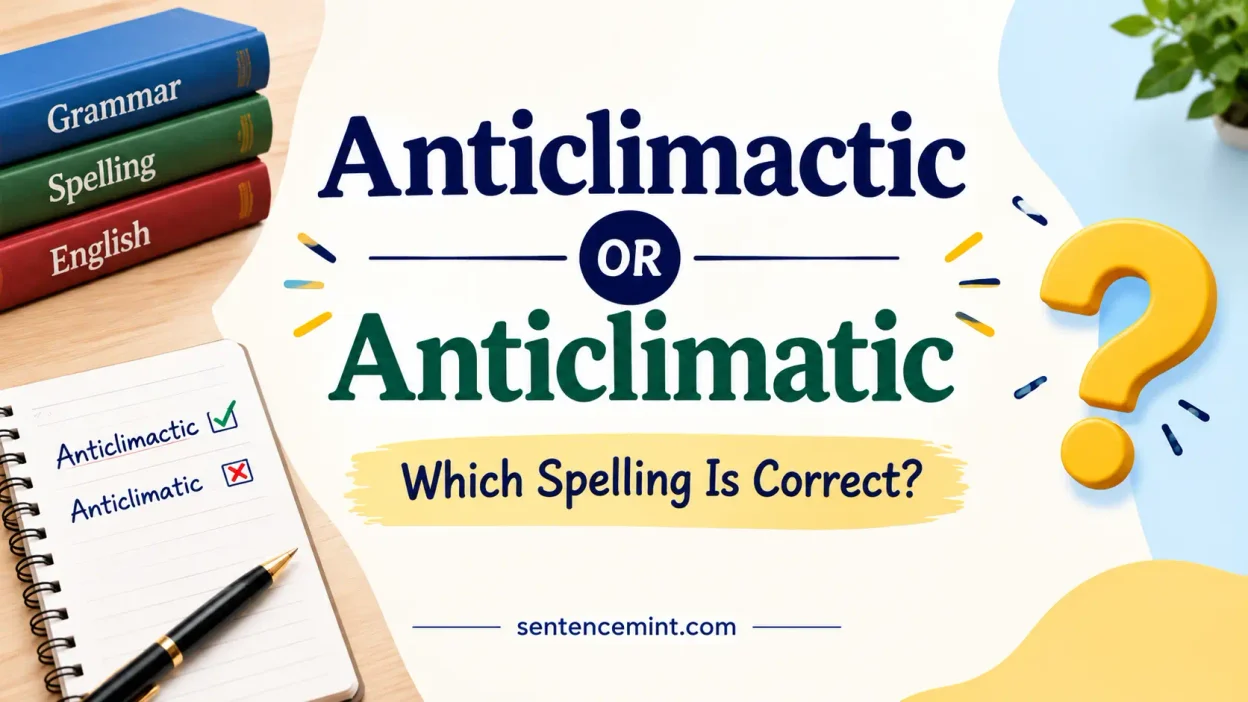
Create a premium 800 × 450 pixel English spelling comparison graphic. Display “ANTICLIMACTIC OR ANTICLIMATIC?” in centered, highly readable typography. Highlight “ANTICLIMACTIC” as the standard spelling. Illustrate a grand stage with dramatic lights fading into an underwhelming, nearly empty finale to represent disappointment after high expectations. Use a sophisticated navy blue, white, and muted gold palette, clean educational styling, strong contrast, balanced spacing, and generous margins. Ensure every word is correctly spelled and fully visible. No watermark.
Image Alt Text
Anticlimactic or anticlimatic spelling comparison highlighting anticlimactic as the standard English spelling.
Anticlimactic or Anticlimatic: Which Spelling Is Correct?
Choosing between anticlimactic and anticlimatic can be confusing because the two spellings look almost identical. If you want to describe a movie ending that feels disappointing, an event that fails to meet expectations, or an exciting moment that turns out to be underwhelming, anticlimactic is the standard spelling in American English.
The confusion often happens because people associate the word with climax but forget the letters in climactic. The spelling anticlimatic is generally considered a misspelling when the intended meaning is disappointing or lacking a satisfying climax.
Learning the correct spelling also helps you distinguish anticlimactic from climatic, a separate word related to climate.
Quick Answer
Anticlimactic is the correct standard spelling when something is less exciting, impressive, or satisfying than expected. Anticlimatic is generally a misspelling of this word. For example, write “The movie’s ending was anticlimactic” rather than “The movie’s ending was anticlimatic.” Remember that anticlimactic relates to a climax, while climatic relates to climate.
What Does Anticlimactic Mean?
Anticlimactic is an adjective describing something that disappoints because it is less exciting, dramatic, or impressive than people expected. It often refers to the ending of a story, a major event, a long-awaited announcement, or an experience that does not deliver the expected excitement.
For example:
- The movie had an anticlimactic ending.
- After months of preparation, the product launch felt anticlimactic.
- The championship game was exciting, but the final minutes were anticlimactic.
- Everyone expected a dramatic announcement, but the actual news was anticlimactic.
- The birthday party felt anticlimactic after all the excitement leading up to it.
In each sentence, the word suggests a gap between expectations and the actual experience.
An anticlimactic moment does not have to be terrible. It may simply feel ordinary, brief, or less memorable than people hoped.
Anticlimactic vs. Anticlimatic: Key Differences
| Feature | Anticlimactic | Anticlimatic |
|---|---|---|
| Standard spelling for the intended meaning | Yes | No |
| Meaning | Disappointing or less exciting than expected | Usually an unintended misspelling of anticlimactic |
| Related word | Anticlimax | Climatic is a separate word |
| Appropriate for professional writing | Yes | Avoid when anticlimactic is intended |
| Example | The finale was anticlimactic. | The finale was anticlimatic. |
The important distinction is that anticlimactic is the established adjective related to anticlimax. The spelling anticlimatic leaves out the c that appears in climactic.
If you are writing a school assignment, review, email, or professional document, choose anticlimactic.
Why Is Anticlimactic the Correct Spelling?
The word is formed from anti- and climactic. The prefix anti- can express opposition or contrast, while climactic relates to a climax, or a high point in a sequence of events.
The spelling follows this pattern:
anti + climactic = anticlimactic
The word retains the c in climactic. Removing that letter produces the common misspelling anticlimatic.
A useful way to remember the spelling is to start with the related noun anticlimax. An anticlimax is a disappointing or unexpectedly weak ending or result. The adjective derived from it is anticlimactic.
Examples:
- Noun: The finale was an anticlimax.
- Adjective: The finale was anticlimactic.
- Adverb: The finale ended anticlimactically.
Remembering the relationship between these forms can help you spell the adjective correctly.
When Should You Use Anticlimactic?
Use anticlimactic when the actual outcome feels less impressive, exciting, or satisfying than the buildup suggested.
Movies and television
The word is especially common when discussing stories and their endings.
Examples:
- The mystery was interesting, but the final reveal was anticlimactic.
- After several episodes of suspense, the conclusion felt anticlimactic.
- The sequel had an anticlimactic ending that disappointed many viewers.
The word does not simply mean that an ending is sad or unexpected. It suggests that the ending lacks the impact people anticipated.
Events and celebrations
An event can feel anticlimactic when it does not match the excitement surrounding it.
Examples:
- After planning the trip for a year, arriving at the hotel felt anticlimactic.
- The graduation ceremony was wonderful, but the short after-party was anticlimactic.
- The surprise announcement turned out to be anticlimactic.
Sports and competitions
A competition may feel anticlimactic if the outcome becomes predictable or the final moments lack excitement.
Examples:
- The championship was decided early, making the final quarter anticlimactic.
- Fans expected a close race, but the finish was anticlimactic.
- The rematch was anticlimactic compared with their previous meeting.
Everyday experiences
The word also works in casual conversation.
Examples:
- Getting the new phone was exciting, but setting it up felt anticlimactic.
- After talking about the restaurant for weeks, dinner was anticlimactic.
- The long-awaited announcement was surprisingly anticlimactic.
These examples show that anticlimactic can describe ordinary experiences, not just major dramatic events.
Anticlimactic, Climactic, and Climatic: What Is the Difference?
These words look similar, but their meanings differ. Understanding them can prevent both spelling and word-choice mistakes.
| Word | Meaning | Example |
|---|---|---|
| Anticlimactic | Less exciting or satisfying than expected | The ending was anticlimactic. |
| Climactic | Relating to the climax or most intense point | The climactic scene was thrilling. |
| Climatic | Relating to climate or long-term weather patterns | The study examined climatic changes. |
Climactic relates to the high point of a story, event, or sequence. For example, “The climactic battle was the most exciting part of the film.”
Climatic, on the other hand, relates to climate. For example, “The region experiences significant climatic variation.”
This distinction explains why anticlimatic is a confusing spelling. It resembles climatic, but the intended meaning concerns a climax, not climate.
Common Mistakes With Anticlimactic
Mistake 1: Leaving out the c
Incorrect: The final scene was anticlimatic.
Correct: The final scene was anticlimactic.
Why: The standard spelling retains the c in climactic.
Mistake 2: Confusing anticlimactic with climactic
Incorrect: The disappointing ending was climactic.
Better: The disappointing ending was anticlimactic.
Why: Climactic describes a high point, while anticlimactic describes an outcome that falls short of expectations.
Mistake 3: Using anticlimactic to mean simply bad
Incorrect assumption: Every bad movie is anticlimactic.
Better understanding: A movie is anticlimactic when its ending or outcome is less exciting or satisfying than the buildup leads viewers to expect. A movie can be bad for many other reasons without being anticlimactic.
Mistake 4: Confusing climactic with climatic
Incorrect: The novel’s climatic battle was exciting.
Better: The novel’s climactic battle was exciting.
Why: Climactic refers to the climax of the story. Climatic refers to climate.
Mistake 5: Assuming anticlimactic always describes an ending
Although the word often describes endings, it can also describe an announcement, meeting, performance, or any experience that falls short of expectations.
Example: “The long-awaited meeting was anticlimactic because everyone agreed immediately.”
What Are Some Synonyms for Anticlimactic?
Several words can express a similar idea, but the best alternative depends on the context.
| Synonym | Best Use |
|---|---|
| Disappointing | When something fails to meet expectations |
| Underwhelming | When something has less impact than expected |
| Unimpressive | When something fails to make a strong impression |
| Flat | When an ending or performance lacks energy |
| Unsatisfying | When an outcome does not provide the expected resolution |
| Deflating | When an experience reduces excitement or enthusiasm |
For example, “The finale was underwhelming” conveys a similar idea to “The finale was anticlimactic.” However, anticlimactic more specifically suggests that the result was disappointing in comparison with the buildup or expected high point.
Frequently Asked Questions
Is anticlimactic or anticlimatic correct?
Anticlimactic is the standard spelling when describing something that is less exciting or satisfying than expected. Anticlimatic is generally a misspelling in this context.
What does anticlimactic mean in simple English?
It means that something turns out to be less exciting, dramatic, or impressive than you expected. For example, if a movie builds suspense for two hours but ends with a weak resolution, its ending may feel anticlimactic.
Why is anticlimactic spelled with a c?
The word comes from anti- and climactic. The c is part of the established spelling of climactic, so it remains in anticlimactic. Connecting it to anticlimax can also help you remember the correct form.
Is anticlimactic the same as disappointing?
The meanings overlap, but they are not identical. Disappointing is a broad word for something that fails to meet expectations, while anticlimactic emphasizes the contrast between an anticipated high point and a less impressive result.
What is the difference between climactic and anticlimactic?
Climactic describes the most intense or important point of an event or story. Anticlimactic describes something that feels weaker or less exciting than expected, often after a buildup.
Can a person or event be anticlimactic?
Yes. An event, announcement, performance, meeting, or experience can be anticlimactic. People also sometimes describe a person or their actions as anticlimactic when the result is less impressive than expected.
What is the difference between anticlimactic and climatic?
Anticlimactic describes a disappointing or underwhelming outcome. Climatic relates to climate, including long-term weather patterns and environmental conditions. They are different words with different meanings.
Conclusion
When choosing between anticlimactic and anticlimatic, use anticlimactic for standard American English. It describes an event, ending, or experience that feels less exciting or satisfying than expected.
Remember the connection to climactic and anticlimax. Keep the c in the spelling, and do not confuse it with climatic, which relates to climate. This simple distinction will help you write accurately in reviews, essays, conversations, and professional documents.