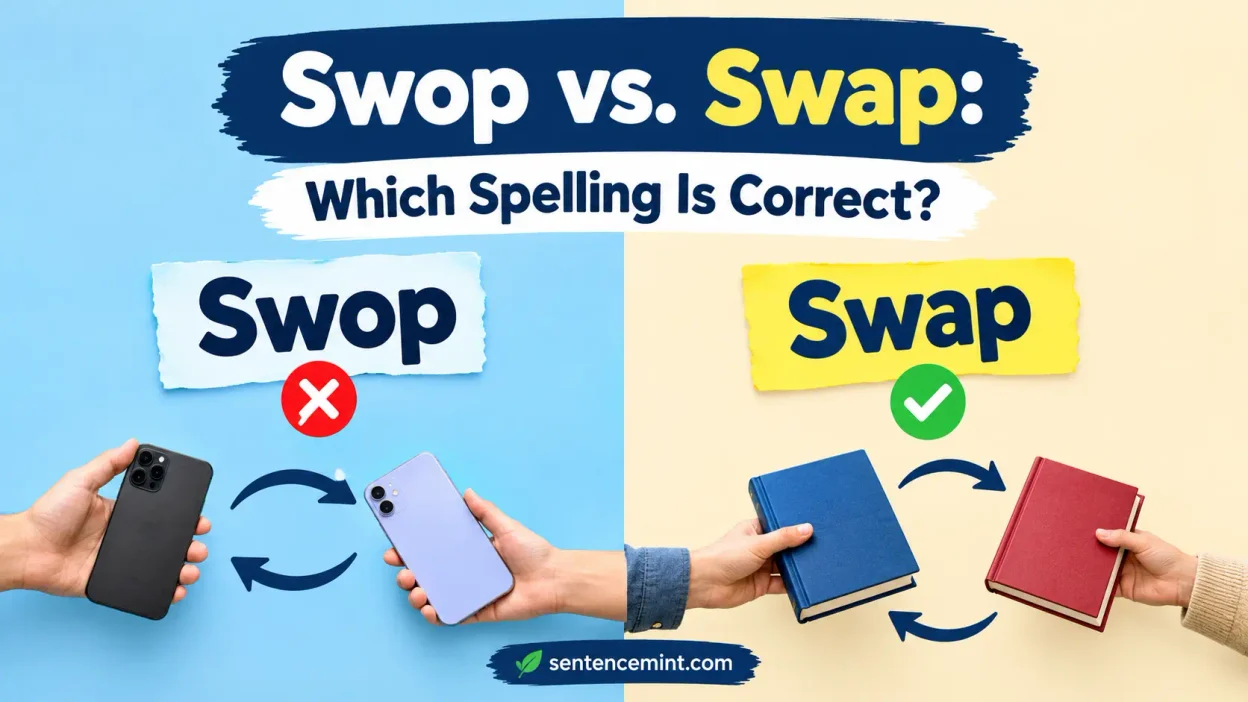
Featured Image Prompt: Create a professional 800×450 HD featured image for an American English grammar website. Display the title “SWOP vs. SWAP” in large, centered, perfectly spelled typography. Highlight “SWAP” as the preferred spelling in modern American English. Use a clean editorial design featuring two objects being exchanged, such as books or gift boxes, with subtle arrows showing the exchange. Use a polished color palette, high contrast, and balanced spacing. Keep all text readable and fully inside the image. No cropped text, extra wording, or watermark.
Image Alt Text: Swop vs. swap spelling comparison showing swap as the preferred spelling in American English.
Quick Answer: Swop vs. Swap
Swap is the standard and preferred spelling in American English. It means to exchange one thing for another or to replace one thing with something else. Swop is a recognized alternative spelling, particularly in British English, but it is much less common in American usage. For most everyday writing, school assignments, business documents, and website content, choose swap.
- Swap: The standard spelling in American English.
- Swop: An accepted but less common spelling variant.
- Meaning: To exchange or trade one thing for another.
- Best choice for U.S. readers: Swap.
What Does Swap Mean?
The word swap means to exchange one thing for another. It can describe exchanging objects, changing positions, trading responsibilities, or replacing one option with another.
Swap can function as both a verb and a noun.
As a verb, it describes the act of exchanging something. As a noun, it refers to the exchange itself.
Examples of Swap in a Sentence
- The students decided to swap books after class.
- Can we swap seats so I can sit near the window?
- I need to swap my old phone for a newer model.
- The two employees agreed to swap shifts.
- We swapped ideas during the meeting.
- She asked her brother to swap his blue shirt for her red one.
- The team plans to swap players before the next game.
- They decided to swap recipes and try each other’s favorite dishes.
In each example, swap describes an exchange or change.
Swap as a Noun
Swap can also refer to an exchange between people or organizations.
Examples:
- The book swap attracted dozens of readers.
- We organized a clothing swap at school.
- The friends arranged a snack swap for lunch.
- The company completed a currency swap.
The meaning depends on the context, but the basic idea of exchanging or substituting remains central.
What Does Swop Mean?
Swop is an alternative spelling of swap. It generally carries the same meaning: to exchange something or make a trade.
For example:
- The children decided to swop toys.
- She asked to swop seats with her friend.
These sentences communicate the same idea as sentences using swap. However, swop is much less common in modern American English.
You may encounter swop in British English or in publications that use this variant. It is not generally necessary to use it because swap is widely understood across English-speaking regions.
Is Swop Incorrect?
Not necessarily. Swop is a recognized spelling variant, rather than simply a made-up word. However, swap is the more familiar and widely preferred spelling, particularly in American English.
For example:
Preferred: We agreed to swap our books.
Less common: We agreed to swop our books.
Both sentences express an exchange, but the first is the safer choice for most readers.
Swop vs. Swap: Comparison Table
| Feature | Swap | Swop |
|---|---|---|
| Spelling | Standard form | Alternative spelling |
| Meaning | Exchange or trade | Exchange or trade |
| American English | Preferred | Less common |
| British English | Common | Also recognized |
| Use in professional writing | Recommended | Usually unnecessary |
| Common expressions | Swap places, swap shifts, swap stories | Same basic expressions |
| Best choice for general writing | Yes | Usually not |
The difference is mainly spelling preference, not meaning. If you are writing for an American audience, use swap consistently.
Is Swap or Swop Correct in American English?
Both forms are recognized, but swap is the standard choice in American English. It is common in everyday conversation, journalism, business communication, and online writing.
Examples:
- Let’s swap contact information.
- The employees agreed to swap shifts.
- I want to swap this item for a different size.
- The players decided to swap jerseys after the game.
These sentences sound natural to American readers.
Swop may appear in some English-language publications, but it is less familiar in the United States. Unless you are following a particular publication’s spelling preference or quoting a source, swap is the better option.
Is Swop or Swap Correct in British English?
Swap is also widely used in British English. Swop is recognized as a variant, so it is not necessarily incorrect in British writing.
For example:
- Common spelling: The children swapped toys.
- Alternative spelling: The children swopped toys.
Both versions express the idea of exchanging toys. However, swap and its forms are generally more familiar to a broad international audience.
If your content targets readers in the United States, the United Kingdom, or multiple English-speaking countries, swap is a practical choice.
Swap vs. Exchange: What Is the Difference?
Swap and exchange have similar meanings, but they differ slightly in tone and usage.
Swap is often informal and suggests that two people exchange things with each other. Exchange is more formal and can describe a wider range of transactions or transfers.
| Word | Meaning | Example |
|---|---|---|
| Swap | Exchange one thing for another, often informally | We decided to swap books. |
| Exchange | Give one thing and receive another | The store allowed me to exchange the shirt. |
| Trade | Exchange goods, services, or assets | They traded baseball cards. |
| Replace | Put something new in place of something else | We replaced the broken screen. |
For example, friends might swap snacks during lunch, while a customer might exchange a defective product at a store.
The words overlap, so the best choice depends on the context and tone.
Common Expressions That Use Swap
Swap appears in many everyday expressions. Learning these phrases can help you remember the standard spelling.
| Expression | Meaning | Example |
|---|---|---|
| Swap places | Exchange positions | Can we swap places? |
| Swap seats | Exchange seating positions | We swapped seats on the bus. |
| Swap shifts | Exchange work schedules | The nurses agreed to swap shifts. |
| Swap stories | Share experiences with one another | The travelers swapped stories. |
| Swap ideas | Exchange thoughts or suggestions | The team swapped ideas during lunch. |
| Swap roles | Exchange responsibilities or positions | The actors swapped roles for the final scene. |
| Swap numbers | Exchange phone numbers | We swapped numbers after the meeting. |
| Swap something for something else | Exchange one item for another | I swapped my old jacket for a new one. |
In all these expressions, swap is the preferred spelling for American English.
Common Mistakes with Swop and Swap
Writers sometimes use the less common spelling without realizing that swap is more widely preferred. Here are a few mistakes to avoid.
Mistake 1: Using Swop in Standard American Writing
Less preferred: We decided to swop our lunch items.
Recommended: We decided to swap our lunch items.
The second sentence uses the standard spelling expected by most American readers.
Mistake 2: Assuming Swop Has a Different Meaning
Swop generally means the same thing as swap. The main difference is spelling preference.
Example: They swapped their books after class.
Changing swapped to swopped does not usually change the intended meaning, although the latter is less common.
Mistake 3: Confusing Swap with Replace
Swap often suggests an exchange, while replace focuses on putting something else in place of an existing item.
Swap: I swapped my blue shirt for a black one.
Replace: I replaced my damaged shirt with a new one.
The first example emphasizes exchanging one shirt for another. The second emphasizes getting rid of the damaged item and using a new one.
Mistake 4: Using the Wrong Past Tense
The standard past tense of swap is swapped.
- We swapped seats.
- They swapped phone numbers.
- She swapped her shift with a colleague.
The spelling swopped is also associated with the variant swop, but swapped is the more familiar form for general American English.
Mistake 5: Switching Between Both Spellings
Using swap in one paragraph and swop in another may make a document look inconsistent.
Better approach: Choose swap throughout an article, report, or website unless you are quoting a source or following a specific spelling convention.
How to Remember the Correct Spelling
A simple memory trick can help you remember the preferred form.
Think of the phrase “swap places.” This common expression uses the spelling with an a.
Remember these three rules:
- Use swap in standard American English.
- Use swapped for the usual past tense.
- Recognize swop as a less common alternative, not the preferred form for most U.S. writing.
For example:
- Present: We swap books.
- Past: We swapped books.
- Future: We will swap books.
This pattern helps you use the word naturally in different tenses.
Frequently Asked Questions
1. Is it swop or swap?
Swap is the standard and preferred spelling in American English. Swop is a recognized alternative spelling but is less common, especially in the United States.
2. Is swop a real word?
Yes. Swop is recognized as a variant of swap. It means to exchange or trade something, but swap is more widely used in modern English.
3. Is swap correct in British English?
Yes. Swap is widely used in British English, too. Swop is also recognized as a variant, but it is not necessary to use it.
4. What is the past tense of swap?
The standard past tense is swapped.
Example: We swapped seats before the movie began.
5. What is the difference between swap and exchange?
Swap usually describes an informal exchange between people or things. Exchange is more formal and can describe a broader range of transactions. Their meanings sometimes overlap.
6. Should I use swop in an American English article?
Generally, no. Use swap because it is the standard spelling familiar to American readers. Swop is worth mentioning only when discussing spelling variations.
7. Can swap be a noun?
Yes. Swap can be a noun or a verb. For example, “We organized a book swap” uses swap as a noun, while “We swapped books” uses it as a verb.
8. Are swopped and swapped both correct?
Swopped is associated with the variant swop, while swapped is the standard past-tense form used with swap. Swapped is the better choice for most modern American English writing.
Practice Quiz: Swop vs. Swap
Choose the best answer for each sentence.
1. The students decided to ______ books after class.
- A. swop
- B. swap
2. We ______ seats so everyone could see the screen.
- A. swapped
- B. swopped
3. Which spelling is preferred in American English?
- A. Swop
- B. Swap
4. The store allowed me to ______ the shirt for a larger size.
- A. swap
- B. swop
5. The friends arranged a book ______ at school.
- A. swap
- B. swop
Quiz Answers
- B. Swap — This is the standard spelling.
- A. Swapped — This is the usual past tense in American English.
- B. Swap — It is the preferred spelling for U.S. readers.
- A. Swap — It describes exchanging one item for another.
- A. Swap — This is the standard spelling in the expression book swap.
Conclusion
When choosing between swop and swap, swap is the best choice for most modern American English writing. Both spellings can express the idea of exchanging or trading something, but swap is more familiar and widely preferred.
Use swap in everyday conversations, school assignments, professional documents, and website articles. You can recognize swop as an alternative spelling, especially in some British English contexts, but there is usually no reason to prefer it.