
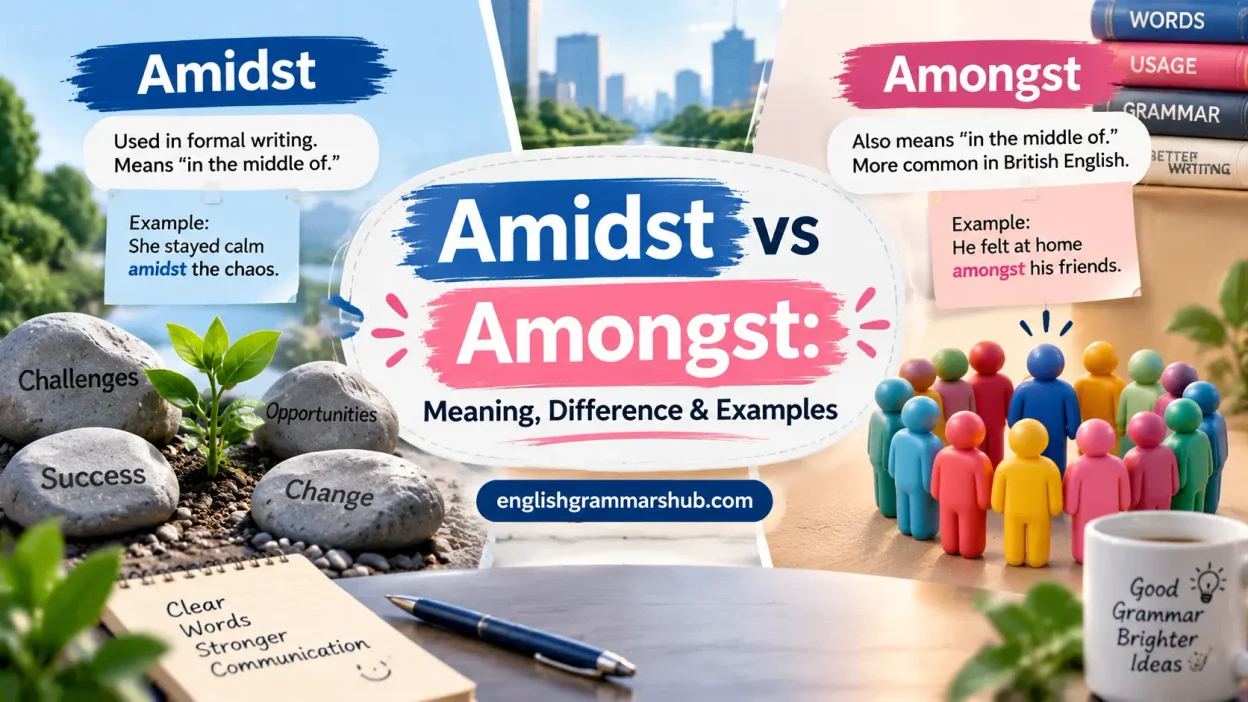
Featured Image Prompt
Create a professional educational comparison image for “Amidst vs Amongst.” Show one side representing being surrounded by something (amidst a forest or crowd) and the other side representing being among a group of people or objects. Use a clean language-learning design, realistic visuals, bold centered typography, and a balanced 16:9 layout.
Image Alt Text
Comparison graphic showing amidst as being surrounded by something and amongst as being within a group.
Amidst vs Amongst: What’s the Difference?
Amidst and amongst are similar-looking words that often confuse English learners, but they are used in different situations. Both words describe being surrounded by something or being in the middle of something, but the context determines which word sounds natural.
Amidst means in the middle of or surrounded by something, often a situation, environment, or mass of things.
Amongst means among a group of people, objects, or things. It is mainly a British English variant of among.
The simple difference:
Amidst = in the middle of something, surrounded by it.
Amongst = within a group or collection.
For example:
- She stood amidst the trees.
- He felt comfortable amongst his friends.
The first focuses on the surroundings. The second focuses on being part of a group.
Quick Answer
Amidst and amongst both mean “in the middle of” or “surrounded by,” but they are used differently. Amidst is commonly used for surroundings, situations, or things around someone. Amongst is used for being within a group or collection and is more common in British English. In American English, “among” is usually preferred over “amongst.”
Amidst vs Amongst at a Glance
| Word | Meaning | Common Usage | Example |
|---|---|---|---|
| Amidst | In the middle of or surrounded by something | Situations, environments, conditions | She walked amidst the flowers. |
| Amongst | Within a group or among several things | People, objects, groups | He was amongst his friends. |
The main difference:
- Amidst focuses on surroundings or circumstances.
- Amongst focuses on being part of a group.
What Does Amidst Mean?
Amidst is a preposition that means “in the middle of,” “surrounded by,” or “during.”
It is often used when something exists inside a larger environment or situation.
Examples:
The cabin was hidden amidst the mountains.
Meaning:
The cabin was surrounded by mountains.
She remained calm amidst the confusion.
Meaning:
She stayed calm during a confusing situation.
Amidst in Physical Settings
Amidst is commonly used when describing locations or surroundings.
Examples:
- amidst the trees
- amidst the crowd
- amidst the flowers
- amidst the noise
Example:
The small village sits amidst green hills.
Meaning:
The village is surrounded by green hills.
Amidst in Situations
Amidst is also used for abstract situations.
Examples:
The company grew amidst economic challenges.
Meaning:
The company grew while facing difficult conditions.
He found hope amidst hardship.
Meaning:
He found hope during a difficult period.
This use is common in formal and literary writing.
What Does Amongst Mean?
Amongst means “in the middle of,” “surrounded by,” or “part of a group.”
It is a variant of among.
Examples:
She was sitting amongst her classmates.
Meaning:
She was sitting within a group of classmates.
The letter was hidden amongst the papers.
Meaning:
The letter was mixed with other papers.
Amongst in Groups of People
Amongst is often used when talking about groups.
Examples:
- amongst friends
- amongst colleagues
- amongst students
- amongst family members
Example:
He was popular amongst his classmates.
Meaning:
His classmates liked him.
Amongst vs Among
The biggest difference between amongst and among is not meaning but style.
Both mean the same thing.
Examples:
She found herself among strangers.
She found herself amongst strangers.
Both sentences are correct.
However:
- Among is more common in American English.
- Amongst sounds more traditional or British.
For most US writing, among is usually the better choice.
The Main Difference Between Amidst and Amongst
The difference is the type of surrounding.
Amidst
Used when something is surrounded by:
- an environment
- a condition
- a situation
- a large mass
Examples:
A house amidst the forest.
Peace amidst chaos.
Amongst
Used when something is part of:
- a group
- a collection
- several people or objects
Examples:
A student amongst classmates.
A book amongst many others.
A simple comparison:
Amidst = surrounded by an environment.
Amongst = included in a group.
Amidst vs Amongst in Sentences
Compare these examples:
Amidst
The flower grew amidst the weeds.
Meaning:
The flower was surrounded by weeds.
Amongst
The flower was hidden amongst other plants.
Meaning:
The flower was one of many plants.
The difference is subtle but important.
Why Are Amidst and Amongst Confused?
These words are confused because:
- they both describe being surrounded
- they look similar
- they are often used in formal writing
However, they focus on different relationships.
Think:
Amidst describes location or circumstances.
Amongst describes membership in a group.
Common Mistakes With Amidst and Amongst
Mistake 1: Using Amongst for Situations
Incorrect:
He remained amongst difficulties.
Better:
He remained amidst difficulties.
Difficulties are a situation, not a group.
Mistake 2: Using Amidst for People
Possible but less natural:
She was amidst her friends.
Better:
She was amongst her friends.
A group of people usually takes among/amongst.
Mistake 3: Using Amongst in American Formal Writing
Not incorrect:
The results were popular amongst users.
More common in the US:
The results were popular among users.
Among is usually preferred in American English.
Mistake 4: Thinking They Are Always Interchangeable
Sometimes they overlap, but the focus changes.
Example:
He stood amidst the crowd.
Focus: surrounded by the environment.
He stood amongst the crowd.
Focus: being part of the group.
Easy Way to Remember Amidst vs Amongst
Use these memory tricks:
Amidst = Atmosphere
Think:
Amidst describes the surroundings around you.
Example:
Amidst the storm.
Amongst = Among People
Think:
Amongst describes being inside a group.
Example:
Amongst friends.
Remember:
Amidst = environment.
Amongst = group.
Example Sentences With Amidst
- The house stood amidst tall trees.
- She remained positive amidst difficulties.
- The bird disappeared amidst the leaves.
- The town developed amidst rapid changes.
- He found peace amidst nature.
- The castle was hidden amidst the mountains.
- The decision came amidst controversy.
- The artist worked amidst constant noise.
Example Sentences With Amongst
- She felt comfortable amongst her friends.
- The teacher walked amongst the students.
- He found his name amongst the list of winners.
- The book was hidden amongst old papers.
- The leader was respected amongst the community.
- The tradition remains popular amongst younger people.
- She searched amongst the boxes for the document.
- He was standing amongst a large crowd.
Frequently Asked Questions
What is the difference between amidst and amongst?
Amidst means being surrounded by a situation, environment, or condition. Amongst means being within a group of people or things.
Is amidst the same as among?
Not exactly. Amidst usually refers to surroundings or circumstances, while among refers to being part of a group.
Is amongst correct in American English?
Yes, amongst is correct, but it is less common in American English. Most Americans use among instead.
Which is more formal, amidst or amongst?
Both can sound formal or literary. Amidst is often used in formal writing, while amongst is associated more with British English.
Can I use amidst for people?
Yes, but it may sound less natural. For groups of people, among or amongst is usually better.
Is amidst an old-fashioned word?
No. Amidst is still used today, especially in formal, literary, and descriptive writing.
Conclusion
The difference between amidst vs amongst depends on what surrounds someone or something.
Amidst means being in the middle of a situation, environment, or surrounding condition.
Amongst means being part of a group or collection.