English spelling can sometimes be confusing, especially when two words look almost identical. “Dutchess” and “duchess” are a good example. Both spellings may appear similar, but only one is the standard English spelling for the female equivalent of a duke.
If you have ever wondered whether to write “Dutchess” or “Duchess,” you are not alone. The extra letter “t” can make the incorrect version look believable, especially because English contains many words with unusual spelling patterns.
In this article, you will learn which spelling is correct, what the word means, how to use it in sentences, and why people commonly misspell it.
Dutchess or Duchess: Quick Answer
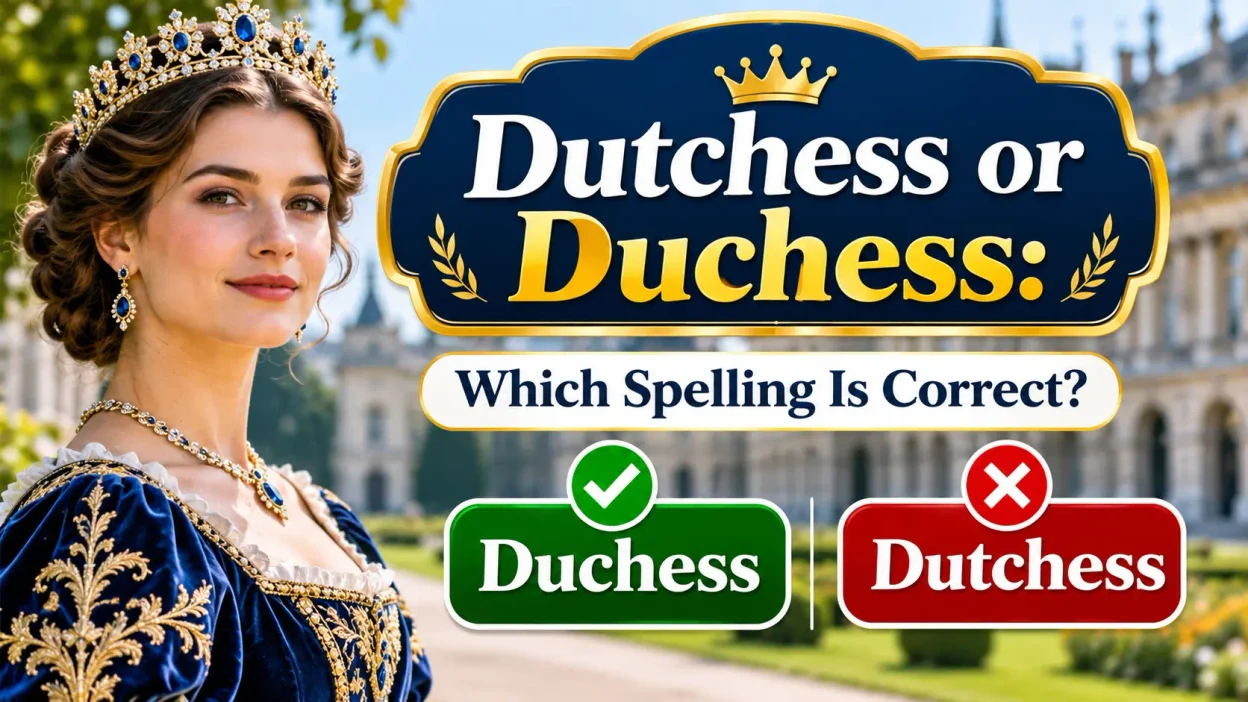
Duchess is the correct standard English spelling when referring to a woman who holds the rank of duke or is the wife or widow of a duke.
Dutchess is generally a misspelling of “duchess” when referring to the royal or noble title.
| Word | Correct or Incorrect? | Meaning |
|---|---|---|
| Duchess | <badge color=”success”>Correct</badge> | A woman holding the rank of duke or the wife or widow of a duke |
| Dutchess | <badge color=”danger”>Incorrect</badge> | Usually a misspelling of duchess |
Correct example: The duchess attended the royal ceremony.
Incorrect example: The dutchess attended the royal ceremony.
Remember: The correct spelling is D-U-C-H-E-S-S, without a “t.”
What Does Duchess Mean?
A duchess is a woman who holds the noble rank of duke in her own right or is the wife or widow of a duke.
The word is associated with aristocracy, royalty, and traditional European systems of nobility. A duchess may receive her title through inheritance, appointment, marriage, or another recognized system of nobility, depending on the country and historical period.
Examples:
- The duchess welcomed guests to the palace.
- She became a duchess after her marriage to a duke.
- The duchess was known for her charitable work.
- Everyone admired the duchess’s elegant appearance.
Different Uses of Duchess
The word “duchess” can be used in different contexts.
1. A woman holding a noble title
A woman who possesses the rank of duke in her own right may be called a duchess.
Example: The duchess inherited her title from her family.
2. The wife or widow of a duke
Traditionally, the wife or widow of a duke is also called a duchess.
Example: The duchess accompanied her husband to the official event.
3. A title used in historical and fictional writing
The word frequently appears in historical novels, royal stories, films, and fairy tales.
Example: The duchess was an important character in the historical novel.
What Does Dutchess Mean?
“Dutchess” is not the standard spelling of the noble title. It is generally considered a spelling mistake when someone intends to write “duchess.”
The mistake usually happens because people assume the word needs a “t,” perhaps because of its pronunciation or confusion with other English words.
However, adding a “t” makes the spelling incorrect in standard English.
Incorrect examples:
- The dutchess visited the castle.
- She was introduced as the dutchess.
- The dutchess wore a beautiful dress.
Correct versions:
- The duchess visited the castle.
- She was introduced as the duchess.
- The duchess wore a beautiful dress.
Can Dutchess Be Used as a Name?
Yes. Although “Dutchess” is not the correct spelling of the noble title, it may appear as a proper name, surname, business name, place name, or other creative name.
For example, a person or organization may intentionally use “Dutchess” as its name. In that context, it should not automatically be treated as a spelling mistake.
The distinction is important: duchess is the standard title, while Dutchess may be a proper name.
Duchess vs Dutchess: Key Differences
| Feature | Duchess | Dutchess |
|---|---|---|
| Standard English spelling | Yes | No, not for the title |
| Meaning | Female equivalent of a duke | No standard title meaning |
| Part of speech | Noun | Usually a proper name when intentionally used |
| Pronunciation | DUCH-ess | Often pronounced similarly when used as a name |
| Common usage | Royalty, nobility, literature | Names, surnames, place names, misspellings |
| Example | The duchess entered the palace. | Dutchess is part of the business name. |
How to Pronounce Duchess
The word duchess is pronounced:
DUCH-ess
It has two syllables:
- Duch – sounds like “duch.”
- Ess – sounds like the letter “S.”
The pronunciation is approximately /ˈdʌtʃ.əs/ in phonetic notation.
The “ch” sound is similar to the sound in “chair” and “child.”
Although “Dutchess” may be pronounced similarly when used as a proper name, that does not make it the correct spelling of the noble title.
Duchess in Sentences: Examples and Usage
Here are some examples showing how to use “duchess” correctly in everyday and formal writing.
Simple sentences:
- The duchess arrived at the royal palace.
- Everyone welcomed the duchess warmly.
- The duchess wore an elegant gown.
- She dreamed of becoming a duchess.
- The duchess attended the charity event.
Formal sentences:
- The duchess participated in an important diplomatic ceremony.
- The duchess supported several educational organizations.
- Members of the royal family greeted the duchess.
- The duchess was respected for her public service.
- The historical record mentioned the duchess’s contribution to the region.
Literary sentences:
- The duchess lived in a magnificent castle surrounded by gardens.
- A mysterious duchess appeared at the royal celebration.
- The young duchess became an influential figure in the kingdom.
Why Do People Confuse Dutchess and Duchess?
There are several reasons why people write “Dutchess” instead of “duchess.”
1. The Extra Letter
Some writers mistakenly add a “t” because they believe it belongs in the word. However, the standard spelling does not include this letter.
2. Pronunciation Confusion
The pronunciation of “duchess” may make its spelling less obvious to English learners. People sometimes add letters that they believe are missing from the spoken word.
3. Typing Mistakes
Fast typing, autocorrect, and spelling suggestions can sometimes contribute to incorrect spelling.
4. Confusion With Proper Names
“Dutchess” appears in some names and place names. Seeing it in those contexts may lead people to assume it is also an alternative spelling of the noble title.
Easy Tricks to Remember the Correct Spelling
Remembering the correct spelling of “duchess” is simple with these tips:
- Remember the missing T: Duchess has no “t” between “u” and “c.”
- Connect it with duke: A duchess is the female equivalent of a duke.
- Practice the spelling: Write D-U-C-H-E-S-S several times.
- Use it in a sentence: “The duchess visited the palace.”
- Check before publishing: If you mean the noble title, always choose “duchess.”
Duchess vs Dutchess: Related Words
Understanding related words can make the spelling easier to remember.
| Word | Meaning |
|---|---|
| Duke | A nobleman of high rank |
| Duchess | A woman holding the rank of duke or the wife or widow of a duke |
| Prince | A male member of a royal family or a ruler of a principality |
| Princess | A female member of a royal family or a woman holding a corresponding title |
| Count | A nobleman with a particular rank in some European systems |
| Countess | A woman holding the rank of count or the wife of a count |
Frequently Asked Questions (FAQs)
1. Is it Dutchess or Duchess?
“Duchess” is the correct spelling for the female noble title. “Dutchess” is generally a misspelling when used with this meaning.
2. What does Duchess mean?
A duchess is a woman who holds the rank of duke in her own right or is the wife or widow of a duke.
3. Is Dutchess a real word?
“Dutchess” can be used as a proper name, surname, business name, or place name. However, it is not the standard spelling of the noble title “duchess.”
4. How do you spell Duchess correctly?
The correct spelling is D-U-C-H-E-S-S. It contains no letter “t.”
5. How do you pronounce Duchess?
“Duchess” is pronounced DUCH-ess, with two syllables. The first syllable sounds like “duch,” and the second sounds like “ess.”
6. Is Duchess the female version of Duke?
Yes. A duchess is the female equivalent of a duke. She may hold the title in her own right or receive it through marriage, depending on the relevant system of nobility.
7. Why is Dutchess incorrect?
“Dutchess” is incorrect when used as the standard spelling of the noble title because the word does not contain a “t.” The correct spelling is “duchess.”
8. Does Duchess need a capital letter?
Use a capital letter when “Duchess” is part of a formal title or appears before a person’s name, depending on the applicable style.
Examples:
- The Duchess of Cambridge attended the event.
- The duchess attended the event.
When used as a general noun, it is normally lowercase.
9. What is the plural of Duchess?
The plural form is duchesses.
Example: Several duchesses attended the royal celebration.
10. Can Dutchess be a person’s name?
Yes. “Dutchess” may be intentionally used as a personal name, surname, or other proper name. Its use as a name does not make it an alternative spelling of the title “duchess.”
Conclusion
When choosing between Dutchess vs Duchess, the correct spelling for the female noble title is duchess. It refers to a woman who holds the rank of duke or is the wife or widow of a duke.
“Dutchess” is generally a spelling mistake in this context, although it can appear as a proper name or surname.
The easiest way to remember the difference is that duchess has no “t.” Whenever you write about royalty, nobility, or a female duke, use “duchess.”