Featured Image Prompt
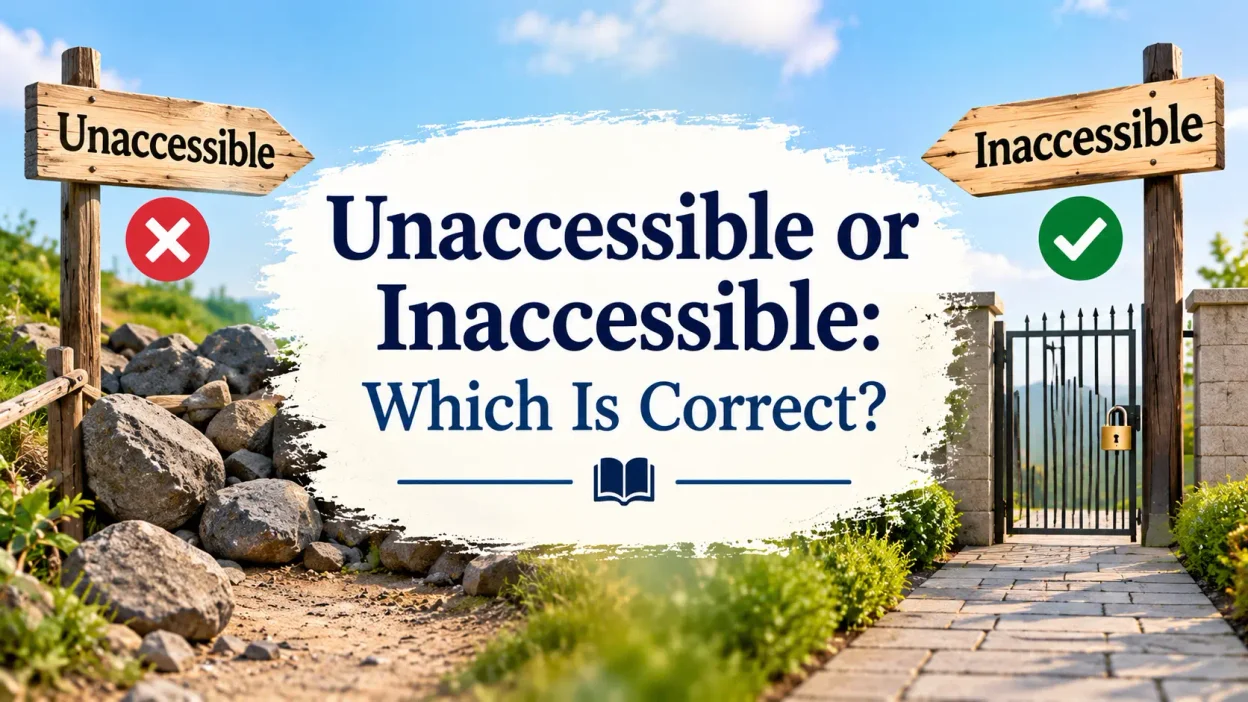
Create a clean 800×450 educational spelling graphic showing “INACCESSIBLE ✓” and “UNACCESSIBLE ✗” in large centered typography, with a locked doorway and an inaccessible path in the background, modern American English learning style, balanced composition, sharp readable typography, professional educational design, no unnecessary text.
Image Alt Text
Educational graphic comparing the correct spelling inaccessible with the less common form unaccessible.
[wtn_news]
Unaccessible or Inaccessible: Which Is Correct?
If you are choosing between unaccessible or inaccessible, inaccessible is the standard and generally preferred word in modern American English.
Inaccessible is an adjective meaning difficult or impossible to reach, obtain, use, or understand. It can describe a physical location, information, a service, a person, or an idea. Cambridge Dictionary
Unaccessible may occasionally be encountered, but it is not the normal choice for standard English. In most situations, especially in American English, use inaccessible.
Quick Answer
Inaccessible is the standard spelling and the best choice in most contexts. It means difficult or impossible to reach, obtain, use, or understand. For example, write “The website is inaccessible” or “The remote village is inaccessible by road.” Cambridge Dictionary
Unaccessible or Inaccessible: Which Is Correct?
The recommended form is:
Inaccessible ✓
The less common form is:
Unaccessible △
For normal modern English writing, inaccessible is the word you should use.
| Word | Standard choice? | Meaning |
|---|---|---|
| inaccessible | ✓ Yes | Difficult or impossible to reach, obtain, use, or understand |
| unaccessible | △ Rare/less preferred | Occasionally encountered, but not the usual standard choice |
Examples:
Correct and natural:
- The building is inaccessible to wheelchair users.
- The information is inaccessible to the public.
- The mountain village is inaccessible by road.
- The article is too technical and inaccessible to beginners.
Usually avoid:
- The building is unaccessible to wheelchair users.
- The information is unaccessible to the public.
For these meanings, inaccessible is the established dictionary form. Cambridge defines it as something very difficult or impossible to reach, obtain, use, or understand. Cambridge Dictionary
What Does Inaccessible Mean?
Inaccessible means that something cannot be reached, obtained, entered, used, or understood easily.
The exact meaning depends on the context.
Difficult or impossible to reach
A physical location can be inaccessible because of its distance, terrain, damage, or other barriers.
- The mountain is inaccessible during the winter.
- The road is inaccessible to large trucks.
- The remote island is inaccessible by car.
Cambridge gives inaccessible the sense of being very difficult or impossible to travel to or reach. Cambridge Dictionary
Difficult to obtain or use
The word can also describe something that people cannot easily get or use.
- The service is inaccessible to low-income families.
- Some historical records remain inaccessible to the public.
- The software is inaccessible without an internet connection.
Difficult to understand
Inaccessible can also describe writing, ideas, lectures, music, or other material that is difficult for people to understand or appreciate.
- The book is inaccessible to beginners.
- His lecture was too technical and inaccessible to most students.
- The article uses language that is inaccessible to general readers.
This meaning is also recognized by Cambridge. Cambridge Dictionary
Why Is Inaccessible Preferred?
English uses many words beginning with in- to express the opposite of an adjective:
- accessible → inaccessible
- accurate → inaccurate
- appropriate → inappropriate
- complete → incomplete
- visible → invisible
Because accessible already has the established negative form inaccessible, that is the normal word used in standard English.
Think of it as:
accessible → inaccessible
rather than:
accessible → unaccessible
The prefix in- does not always work this way with every English adjective, so it is better to learn the established form rather than assume that adding un- will always produce the standard word.
Is Unaccessible a Word?
You may encounter unaccessible in some English texts, but it is not the usual modern choice for the meaning expressed by inaccessible.
For practical writing, especially in American English, use inaccessible.
For example:
Better:
“The website is inaccessible.”
Rather than:
Less standard:
“The website is unaccessible.”
The established dictionary entry is inaccessible, and major English dictionaries use it for meanings such as difficult to reach, obtain, use, or understand. Cambridge Dictionary
Inaccessible as an Adjective
Inaccessible is an adjective.
It describes a person, place, thing, service, idea, or other noun.
Examples:
- an inaccessible building
- an inaccessible location
- inaccessible information
- an inaccessible website
- an inaccessible professor
- an inaccessible text
The word can describe both physical and nonphysical barriers.
For example:
“The trail is inaccessible.”
This means people cannot easily reach or use the trail.
But:
“The textbook is inaccessible to new students.”
Here, it means the textbook is difficult for those students to understand.
How Do You Pronounce Inaccessible?
In American English, inaccessible is pronounced approximately:
in-ak-SES-uh-bul
The U.S. IPA pronunciation is:
/ˌɪn.ækˈses.ə.bəl/ Cambridge Dictionary
The main stress falls on SES:
in-ak-SES-uh-bul
Because the word has several syllables, saying it slowly can help you recognize its structure.
Inaccessible vs. Unavailable
These words are related, but they do not always mean the same thing.
Unavailable usually means something cannot currently be obtained, used, or accessed.
Inaccessible emphasizes difficulty or impossibility of reaching, entering, using, obtaining, or understanding something.
Compare:
“The website is unavailable.”
This may mean the website is temporarily offline.
“The website is inaccessible to users with certain disabilities.”
This indicates that a barrier prevents a particular group from accessing or using it.
Cambridge defines unavailable as something that cannot be used or obtained, or a person who cannot be met or talked to at that time. Cambridge Dictionary
Inaccessible vs. Unreachable
Unreachable is another related word.
Unreachable generally means that something cannot be reached or contacted.
For example:
- The village was unreachable because the road was blocked.
- I tried calling her, but she was unreachable.
Cambridge uses unreachable for places or things that cannot be reached or obtained and for people who cannot be contacted. Cambridge Dictionary
Inaccessible is broader because it can also mean difficult to understand or difficult to use.
For example:
“The article is inaccessible to beginners.”
You would not normally use unreachable to express that meaning.
Inaccessible vs. Unattainable
These words also have different meanings.
Inaccessible means difficult or impossible to reach, access, obtain, use, or understand.
Unattainable means impossible to achieve or reach as a goal.
Compare:
- The website is inaccessible.
- The goal is unattainable.
Cambridge defines unattainable as something that cannot be achieved. Cambridge Dictionary
So if you are talking about a goal that cannot be achieved, unattainable may be the right word.
If you are talking about a building, website, service, or idea that cannot easily be accessed, use inaccessible.
Common Uses of Inaccessible
The word appears naturally in several common patterns.
Inaccessible to someone
This structure identifies who cannot access something.
- The building is inaccessible to wheelchair users.
- The information is inaccessible to the general public.
- The technology is inaccessible to many older users.
This construction is common and is specifically recognized in dictionary usage. Cambridge Dictionary
Inaccessible by something
This structure describes the means of reaching a place.
- The village is inaccessible by road.
- The island is inaccessible by car.
- The area is inaccessible by public transportation.
Inaccessible because of something
This explains the reason.
- The road is inaccessible because of flooding.
- The website became inaccessible because of a technical problem.
- The trail is inaccessible because of heavy snow.
Common Mistakes With Inaccessible
Mistake 1: Writing Unaccessible
Less standard:
“The website is unaccessible.”
Better:
“The website is inaccessible.”
Use the established adjective inaccessible.
Mistake 2: Confusing Inaccessible With Unavailable
“The product is unavailable.”
This usually means you cannot currently obtain or use the product.
“The product is inaccessible.”
This suggests that access itself is difficult or impossible.
The correct word depends on what you are trying to say.
Mistake 3: Using Inaccessible When You Mean Impossible to Achieve
Incorrect meaning:
“The goal is inaccessible.”
If you mean the goal cannot be achieved, unattainable may be more precise.
Better:
“The goal is unattainable.”
Examples of Inaccessible in Sentences
- The remote village is inaccessible by road.
- The building remains inaccessible to wheelchair users.
- Some of the information is inaccessible to the public.
- The website became inaccessible after the server failed.
- The mountain trail is inaccessible during the winter.
- The textbook is too technical and inaccessible to beginners.
- The documents were inaccessible without special permission.
- The area became inaccessible after the bridge collapsed.
- The research is inaccessible to readers without a scientific background.
- The museum is currently inaccessible because of construction.
A Simple Trick to Remember the Spelling
Start with the word:
ACCESSIBLE
Then add IN-:
IN + ACCESSIBLE = INACCESSIBLE
This gives you:
I-N-A-C-C-E-S-S-I-B-L-E
The middle of the word contains access, which can make the spelling easier to remember:
in + access + ible → inaccessible
Remember:
accessible → inaccessible
Not:
accessible → unaccessible
Frequently Asked Questions
Is it unaccessible or inaccessible?
Inaccessible is the standard and preferred form in modern English. Use it when something is difficult or impossible to reach, obtain, use, or understand. Cambridge Dictionary
Is unaccessible grammatically correct?
You may encounter unaccessible, but it is not the usual standard form for this meaning. In normal American English writing, inaccessible is the safer and more established choice.
What does inaccessible mean?
Inaccessible means difficult or impossible to reach, obtain, use, or understand. It can describe physical places, services, information, websites, or ideas. Cambridge Dictionary
Is inaccessible an adjective?
Yes. Inaccessible is an adjective that describes something that cannot easily be reached, obtained, used, or understood.
What is the opposite of inaccessible?
The most direct opposite is accessible. For example, an inaccessible building is difficult or impossible to enter or use, while an accessible building can be reached or used more easily.
What is the difference between inaccessible and unavailable?
Inaccessible emphasizes difficulty or inability to access something. Unavailable generally means something cannot currently be obtained or used, or a person cannot currently be contacted. Cambridge Dictionary
What is the difference between inaccessible and unreachable?
Unreachable focuses on something that cannot be reached or contacted. Inaccessible has a broader range of uses and can also mean difficult to obtain, use, or understand. Cambridge Dictionary
Conclusion
When choosing between unaccessible or inaccessible, use inaccessible in standard American English.
Inaccessible means difficult or impossible to reach, obtain, use, or understand. It can describe a physical location, website, service, information, or even an idea that is difficult for people to understand.
Remember the standard form:
accessible → inaccessible ✓
For most writing, inaccessible is the clear and established choice.